Showing posts with label depression. Show all posts

Saturday, October 12, 2019

FADING MAGIC

The magic thread of its huge haunting spell,
And that linked his life to magic kingdoms
And to lotus-land

--Tom Wolfe

He'd tried his best. For the last twelve weeks, he'd hung his father's shirts on the branches of a tree at Smedley Park, watched a horse race across the field at Linvilla, set his Dad's shoes out on the porch, waited for a train that never came, and watched a ship with a mysterious symbol on its hull float down the Delaware River. He'd kept hope alive in his heart, even as it grew fainter with each passing day, trying to read into the world around him clues about his father's return.

Despite it all, despite his fervent wish, despite the magical thinking that kept him from grieving too deeply, his dad hadn't come back. And now, as more and more pieces of his father were packed up and put away and the sounds of his father's voice became fainter in his memory, he began to think that maybe the magic wouldn't work. Maybe, wherever his father had gone, he just wasn't coming back.

"Why wouldn't Dad want to come back?" Allen asks me one evening.


Inwardly, I sigh. It has been a common theme of our conversation the last three months. Patiently, I give him the same answer I have been giving him all along.  "I'm sure he wants to come back," I say in a level tone. "But I don't think he can. It's like he's in another dimension in heaven. He just can't take a train or a boat to get back to us."

"Sounds stupid to me," says my son who lives on the upper edges of the autism spectrum and understands the world in the most concrete of terms. "If he wants to come back, he should be allowed to."

Ever since Ron passed away in his sleep, quietly slipping from us while my daughter and I were visiting my father, I have struggled to help Allen accept the finality of death. It is a concept illogical to most on the autism spectrum who find comfort in the ability to control the world around them, a world they often find too loud, too colorful, too busy. I have tried to make Allen's life predictable again with routines for the two of us: who cooks dinner, who cleans up, who does the laundry. Every Friday night is market night and take-out supper; every Monday night is pasta and a movie. The routines help Allen whose emotions have been scrambled by his deep loss (Indiana University, 2019). 

Image result for magical thinking


And I have accepted the pieces of magical thinking that has found us spending most Saturdays searching for clues to Ron's return, seeing each of Allen's ideas as a step he needed to take in order to mourn his dad. I have put no time table on it, resolving to participate in the magical journeys as long as Allen needed them.

But the magic appears to be fading. It has been two weeks since we have waited at a train station or checked the shirt Allen hung on a tree. 

"The thing that really bothers me," and Allen pounds his fist on the table to make his point, "is that the night Dad...left"--his voice catches on the word--"he didn't say good-bye. " His voice drops to a whisper. "I wish he'd said good-bye. Then I could have said good-bye to him."

"I know," I tell my son. "I wish that, too. But I don't think Dad knew he was leaving, that God was going to call him to Heaven. I don't think he had time to say good-bye."

"I was just upstairs," says Allen. "If he'd called me, I would have come downstairs."

"I know," I assure him. "And Dad knew you loved him."

Image result for magical thinkingAllen nods his head sadly and is silent for a few moments. I wait, giving him time to process. Then he heaves a huge sigh--full of loss and pain--and closes his eyes. From experience, I know that he is putting his words together carefully. "I guess," he says after a while, "the only thing left to do is to find a way to honor him."

My heart soars. This is a huge step towards acceptance. I nod my head.

"What would you suggest?" I ask.

He shrugs. "Well, maybe like once a month we could cook his favorite foods and play his favorite game," he says.

"That would be good."

"And at Christmas we could still hang his stocking."


Image result for Dad christmas stocking
"Definitely."

"And once in a while we can go outside at night and look at the stars. And think that Dad is looking at them, too."

I hold back my tears and nod. "Sounds good. And when Bonnie and Dennis are here on Sunday for your birthday, we're going to go put the flag from the VA on Dad's grave."

He is thoughtful. "My first birthday without Dad."

"I know. It's sad, but we'll all be together."

"Okay. Maybe we can sing the birthday song in the off-key crazy way Dad had."

"Of course," I say. "It's a family tradition."

Allen smiles at me and walks into the kitchen to get a snack. "I'm making you tea!" he says.

"Nice," I say. Magical thinking may not bring his father back, but it has been helping Allen cope with his loss and move into a world without his father at his own pace and in his own time. I hear him in the kitchen now, talking to himself as he fills the tea kettle, takes a mug from the cabinet, gathers up the creamer and the sugar. Step by step, he reminds himself what needs to be done. He gets to the other side of the task.

He, like his brother and sister, is getting to the other side, beginning to imagine life without Ron.

I look at the family picture on the shelf next to my desk, a photo taken years ago when the kids were small and Ron was well. On some plane, on some level, Ron still exists. Then I feel a tear escape from my eye. I, too, am learning to move into a life without my husband. 

I think I am going to miss the Saturday journeys. Even though I knew Allen's magical thinking would not bring Ron back, it was nice to keep the magic alive just a while longer. 


No photo description available.


Monday, July 16, 2018

BROKEN DOLLS


Psalm 42:11
Why, my soul, are you downcast?
    Why so disturbed within me?
Put your hope in God,
    for I will yet praise him,
    my Savior and my God

Image result for china dolls     I have a confession to make: I am afraid of china-headed dolls. It’s okay if you laughed; my sixth grade students always did when we talked about our fears and hopes for the new school year. Like most fears that might appear irrational, mine is seated in reality.

     My grandmother loved dolls and she had quite a few of the china-headed variety, including one with eyes that could open and close. She decided to have the wig section—a removable part of the head—replaced. And she showed me what it looked like on the inside—shudder—of the dolly.

     I was horrified.

Infographic     If you’ve never peeked into the head of a china doll, I advise against it. While the doll may look lifelike, on the inside the eyes are joined by a metal bar and a weight hangs from it into the empty head, an ingenuous little mechanism designed to make the eyes open and close and scare little girls to death.

     This past Sunday, I listened to Pastor Tim talk about the invisibility of mental illness, depression, and other funky feelings, and my mind clearly recalled the interior of that doll’s head. I began to wonder what other things might be happening inside people’s heads, things that none of us on the outside can see.

     The National Institute of Mental Illness (2018) ascertains that 1 in 5 adult Americans will suffer or have suffered with some form of mental illness. That’s 44.7 million people keeping an  invisible weight inside their heads. Anxiety disorders will affect 31.1% of the population. And bipolar disorder will affect 4.4%. Contrary to popular belief, most people who suffer from a mental illness are functional in society; they hold down jobs, care for their families, are responsible citizens, and sit in a church service on Sunday.

Image result for neurotransmitters
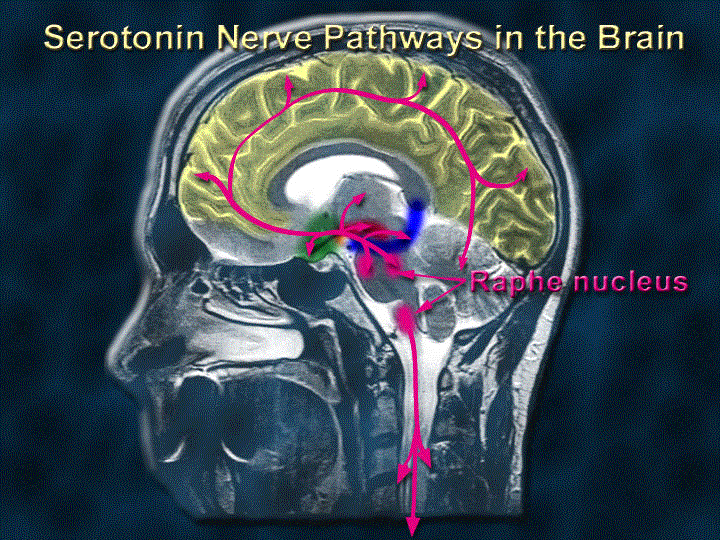
     Doctors and researchers have only the most basic understanding of the complexities that can lead to mental illness, but all agree that the neurotransmitters of the brain emit serotonin into the synapses—the spaces—between the transmitters. The less serotonin that’s emitted, the more severe the mental illness. Certain medications can help increase the amount of serotonin that’s making the leap from one transmitter to the other and not getting lost in the process.

     And what about those of us who are Christians? Are we included in that 20% statistic of dealing with a mental illness? Yep. The insides of our heads can be as horrid as Grandma’s china doll. We don’t always react well to the notion that the person sitting next to us in the pew is dealing with a mental or emotional problem. Back in Grandma’s day, people who had severe cases of mental illness were “put away,” a colloquialism for institutionalized. Unfortunately, a misunderstanding of mental illness continues to exist.

Image result for hippocrates     But mental illness in its many forms is not a twenty-first century problem. Hippocrates, a Greek physician who lived around 400 BC, believed that all illnesses—physical or mental—were caused by an imbalance in the body’s organic processes. He strove to have mental illness understood as a genuine medical problem. Many theologians have hypothesized that King David, who reigned over Israel more than 3500 years ago, was afflicted with depression. In fact, Louba Ben-Noun published a thesis in History of Psychiatry (2004) which uses the Psalms to diagnose David on the DSM-IV scale used by mental health workers.

      Six symptoms are needed for a diagnosis and, according to Ben-Noun, David possessed all six. A depressed mood is clearly revealed in Psalm 51:19, when David cried out that he has a “broken and depressed heart”. Psalm 48:9 further states, “I am feeble and depressed.” Significant weight loss may also be associated with severe depression, and in Psalm 109:24 David cries, “My knees are weak from fasting and my flesh failed of fatness. ” 

Image result for King David     Ben-Noun finds further evidence in Psalm 109:7 which might indicate insomnia and Psalm 55:5 which might be an example of psychomotor agitation. Loss of energy is described in Psalm 31:11 and feelings of worthlessness—“disgrace of man”—in Psalm 22:7.

     Despite lack of an official diagnosis, it is clear that David had struggles. He needed to flee for his life from King Saul, lost his best friend Jonathan and his son Absalom, and had the stress of leading Israel. But even down and out, David never forsook God. Nor did God ever forsake him. Just sometimes God was hard to see.

     And David wasn’t the only Biblical character whose movable eyes sometimes had trouble seeing God. Writing for Crosswalk.com, McDaniel (2017) reminds us that Elijah was so discouraged he told God to take his life (1 Kings 19:4), Jonah ran away from his circumstances and was “angry enough to die” (Jonah 4:9), and Moses was so discouraged he was ready to throw in his rod and staff and call it a day (Exodus 32:32).

     While the examples of those who have suffered before us might make us feel less alone when battling mental issues, what we need are practical steps to keep us from falling into the “I’m a horrible Christian if I can’t get out of this funk” hole. Pastor Tim provided us with ways to keep moving forward even while our minds are pulled down with an ugly weight.

1.       Start the nod. It’s okay to be sad. The Christian walk’s not always a piece of cake. Ask for help from those sitting in the pews around you. I promise you they don’t have china heads, but real working ears.

Image result for the joy of the lord is my strength verse2.       Do the Word Walk. The Bible is chock-full of those who felt depression and anxiety and turned to God, not Google.

3.       Wiggle just a little. “Pain is possible when joy is present,” Pastor Tim said. You may not be jumping up and down when it’s all you can do to get out of bed, but rejoice in what you can do. And realize happiness is only a temporary space in time but joy is found in the Lord (Nehemiah 8:10).

     I’m still not crazy about china-headed dolls, whose hollow heads and mechanical eyes remind me that we can all be broken. But when my Grandma died, her beloved doll came to live with me. I am all too aware of what the  inside of her head looks like.

     So I make her wear a hat.
Image result for china dolls


Thursday, October 17, 2013

Drink Me!


http://www.daviddarling.info/images/Alice_Through_the_Looking_Glass.jpgThe cabinet over the kitchen sink holds a multitude of little green bottles; almost all of them have Ron's name on them. Over the years, we have accumulated quite a collection! I am not a scientist, but I can reel off the names of the drugs that have been prescribed to him: Cymbalta, Wellbutrin, Lexapro for depression, Respridal, Klonopin, and Depakote for Bipolar disorder, Coreg for congestive heart failure. Years ago we had a round with Abilify, star of many commercials featuring a dark cloud, but Ron had a--well, let's just call it negative--reaction to it. Shudder. Now I look them all up, preparing myself for possible side effects and a trip to the other side of the looking glass.

So, let's see what Tizanidine, the most recent of the meds to join our extensive collection, will have to offer our family. Do I need to hide the sharp objects? A small, round white pill, it looks innocuous enough. Dr. Aradillas prescribed it for Ron on Monday. Most commonly, Tizanidine is used for relief from muscle spasms. During the exam, Dr. Aradillas found that Ron's extremities--hands and feet--often spasm in sympathy with the damaged abdominal nerves. This is why Ron often feels the need to sit on the side of the bed at night, stretching out his arms and rocking back and forth. It explains it, but it does not help me cope with the swaying of the bed or the slightly queasy feeling in my stomach.

http://www.gutenberg.org/files/114/114-h/images/alice04a.gifIn other news, however, the Tizanidine does just what we hope the Ketamine will do: it blocks the brain from receiving the signals from the nerves. Ron's first dose put him in such a relaxed state that he fell asleep at Allen's birthday dinner. No one would have minded, except that we were in a restaurant at the time. Luckily, both Allen and Jared are strapping young men so we managed to maneuver Ron home. Lesson learned: only take Tizanidine while home. Ron had a pretty good night's sleep with no rocking motions, although his snoring would wake the dead but that's a whole other problem and not one we think Tizanidine can help.


Here's the trick, though, to dealing with traumatic brain injury; a damaged brain does not always react to drugs in the same way that a "normal" brain would. More than once, a drug that was supposed to cause only mild reactions made my dear husband into a raving lunatic. And on several occasions, a drug so depressed his systems that he hung in a near coma state. I slept with the phone next to me during the night, alert to signs that the Tizanidine might not be all it was cracked up to be and ready to dial 911. Snoring aside, I wasn't sleeping much.

Ron was still breathing normally--for him--this morning so I went off to work. Allen was home all day but my phone didn't ring once. And when I walked in the door at 5:30, Ron was sitting happily on the couch and watching ESPN. It is possible that his color looked better. It is also possible I was too tired to tell.

But this much is clear: the Tizanidine seems to be doing exactly what it is supposed to do. It is a small but important miracle.

Maybe I'll actually sleep tonight.