Tuesday, July 24, 2018

YOU GET WHAT YOU GET. (And you don't get upset.)


20 Yet he did not waver through unbelief regarding the promise of God, but was strengthened in his faith and gave glory to God, 21 being fully persuaded that God had power to do what he had promised.

Romans 4:20-21
Marquee Incentive Charts With Mini Stickers by Teacher Created Resources 
“I want a purple sticker,” said Astrid.

“There are no purple ones left,” said my daughter, teacher of this precocious two-year-old. ““There are green and yellow ones.”

Astrid stamped her foot. “But I want a purple one!”

‘Well,” said my patient daughter, “we don’t always get what we want. Sometimes we get what we get and we don’t get upset.”

While this philosophy is reinforced often in the pre-school classroom my daughter teaches, Astrid—and her age mates—don’t always agree. Astrid folded her arms across her chest and got upset. Very upset. So upset she was sent to the time-out chair.

Image result for Jeremiah 29:11-13Are we ever like Astrid? I know I am. I tell God all about the wonderful plans I have for my life, if only He would get on board with them. He tells me that He’s got better plans for me. In fact, the words from Jeremiah 29:11-13 hang on a plaque in my living room. But honestly, when I’m trying to juggle three jobs and find a way to pay for ever-increasing medical costs, I want to stamp my foot like Astrid and get my own way.

And I’ll just bet I’m not alone. The Bible is chockablock of people who didn’t wait for God’s plan to come to fruition but rushed ahead of Him. Sarah, wife of Abraham whose faith in God’s promises of many descendants never wavered, didn’t side with her husband. She took matters into her own hands by giving Hagar, her maid, to Abraham as a concubine. The result? Broken relationships and exile.

Image result for Rachel and Jacob
In Genesis 27:8-17, Rebekah conspired to have her husband Isaac bless Jacob when the birthright should have gone to Esau, the first born. The result was more broken relationships and exile. Rebekah never saw her beloved son Jacob again. And in Genesis 30:1, Rachel, wife of the banished Jacob, became discouraged at her lack of ability to conceive and gave her husband her maid servant as concubine. Guess what? Broken relationships and exile.

Yet the vast majority of Americans say they trust God and depend on Him for help. Writing for  The New York Times in 2010, Tara Parker-Pope reported on two surveys conducted to determine how people’s health was affected by their belief in God and His role in their lives. Data obtained from The Baylor Religion Institute Survey and the Work, Stress, Health Survey indicated that 82% of the respondents regularly depended on God for help and 71% believed the events in their lives were influenced by God.

So if everybody’s doing it, why can’t we?

The answer is surprisingly simple and has to do with something we all want: control. Just like it’s really hard for me to be the passenger in the car—even though I hate to drive—it’s difficult to totally give control of our lives over to a Higher Power, even if we claim we are. We might say we trust God and depend on Him-and 82% of us do—but when it comes right down to it, we’re a bit scared to put it to the test. We’d like a safety net under that ledge, please, and perhaps the firemen standing by.

Image result for 82%But what if we REALLY trusted God? Not just said so on Sunday and went our own way on Monday. What if we whole-heartedly chose to believe in Hebrews 11:1 and put our faith in our pockets each day along with our cell phones? What if, instead of stamping our feet and crossing our arms and being upset we didn’t get a purple sticker, we decided to be grown-ups about it?

On Sunday, Pastor Aaron talked to us about having real conversations—not grumbles—with God. After all, He can take it. These are his five suggestions:

1.      Stop pretending. While 82% of Americans say they believe God plays an active role in their lives, the same percentage are likely to hold onto their disappointments and challenges lest anyone think they’re not trusting God. Let’s let God search our hearts (Psalm 139:23-24) and let’s share the truth about how we feel.

2.      Confess when you’re wrong. We all act stupid sometimes and we all want our own way. God already knows whatever you’re going to confess, be it to Him or another person.

3.      Tell God how you feel. It’s okay to be disappointed you didn’t get the job or win the lottery. David was honest with God about his disappointments! Once you get rid of the negative emotions, God can fill it with positive things.
Image result for a fish looks like a gorilla
4.      Tell God you love Him. That doesn’t mean you always understand where He leads you. But reminding yourself of God’s attributes will remind you of why you should trust Him.

5.      Tell God you’re puzzled. Life doesn’t always look good. Sometimes a fish looks like a gorilla. Sometimes we can’t tell what the heck it looks like. But we can trust that God has made it for us. So it’s got to be awesome.

And back to Astrid, who spent the allotted minutes in time-out and decided that a yellow sticker would be okay. So my daughter affixed a yellow sticker to Astrid’s chart and the child went off to play. The next day, when sticker time came around, my daughter held out the choices to Astrid. The little girl studied them for a moment, then put her arms around her teacher and said, “You choose. I trust you, Miss Bonnie.”

Good for you, Astrid! I’m trying to learn to trust God that way, too, no matter what color sticker He gives me.
 Image result for trust god

Monday, July 16, 2018

BROKEN DOLLS


Psalm 42:11
Why, my soul, are you downcast?
    Why so disturbed within me?
Put your hope in God,
    for I will yet praise him,
    my Savior and my God

Image result for china dolls     I have a confession to make: I am afraid of china-headed dolls. It’s okay if you laughed; my sixth grade students always did when we talked about our fears and hopes for the new school year. Like most fears that might appear irrational, mine is seated in reality.

     My grandmother loved dolls and she had quite a few of the china-headed variety, including one with eyes that could open and close. She decided to have the wig section—a removable part of the head—replaced. And she showed me what it looked like on the inside—shudder—of the dolly.

     I was horrified.

Infographic     If you’ve never peeked into the head of a china doll, I advise against it. While the doll may look lifelike, on the inside the eyes are joined by a metal bar and a weight hangs from it into the empty head, an ingenuous little mechanism designed to make the eyes open and close and scare little girls to death.

     This past Sunday, I listened to Pastor Tim talk about the invisibility of mental illness, depression, and other funky feelings, and my mind clearly recalled the interior of that doll’s head. I began to wonder what other things might be happening inside people’s heads, things that none of us on the outside can see.

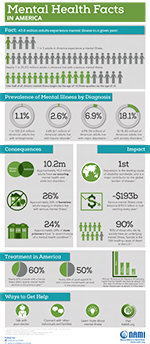
     The National Institute of Mental Illness (2018) ascertains that 1 in 5 adult Americans will suffer or have suffered with some form of mental illness. That’s 44.7 million people keeping an  invisible weight inside their heads. Anxiety disorders will affect 31.1% of the population. And bipolar disorder will affect 4.4%. Contrary to popular belief, most people who suffer from a mental illness are functional in society; they hold down jobs, care for their families, are responsible citizens, and sit in a church service on Sunday.

Image result for neurotransmitters
     Doctors and researchers have only the most basic understanding of the complexities that can lead to mental illness, but all agree that the neurotransmitters of the brain emit serotonin into the synapses—the spaces—between the transmitters. The less serotonin that’s emitted, the more severe the mental illness. Certain medications can help increase the amount of serotonin that’s making the leap from one transmitter to the other and not getting lost in the process.

     And what about those of us who are Christians? Are we included in that 20% statistic of dealing with a mental illness? Yep. The insides of our heads can be as horrid as Grandma’s china doll. We don’t always react well to the notion that the person sitting next to us in the pew is dealing with a mental or emotional problem. Back in Grandma’s day, people who had severe cases of mental illness were “put away,” a colloquialism for institutionalized. Unfortunately, a misunderstanding of mental illness continues to exist.

Image result for hippocrates     But mental illness in its many forms is not a twenty-first century problem. Hippocrates, a Greek physician who lived around 400 BC, believed that all illnesses—physical or mental—were caused by an imbalance in the body’s organic processes. He strove to have mental illness understood as a genuine medical problem. Many theologians have hypothesized that King David, who reigned over Israel more than 3500 years ago, was afflicted with depression. In fact, Louba Ben-Noun published a thesis in History of Psychiatry (2004) which uses the Psalms to diagnose David on the DSM-IV scale used by mental health workers.

      Six symptoms are needed for a diagnosis and, according to Ben-Noun, David possessed all six. A depressed mood is clearly revealed in Psalm 51:19, when David cried out that he has a “broken and depressed heart”. Psalm 48:9 further states, “I am feeble and depressed.” Significant weight loss may also be associated with severe depression, and in Psalm 109:24 David cries, “My knees are weak from fasting and my flesh failed of fatness. ” 

Image result for King David     Ben-Noun finds further evidence in Psalm 109:7 which might indicate insomnia and Psalm 55:5 which might be an example of psychomotor agitation. Loss of energy is described in Psalm 31:11 and feelings of worthlessness—“disgrace of man”—in Psalm 22:7.

     Despite lack of an official diagnosis, it is clear that David had struggles. He needed to flee for his life from King Saul, lost his best friend Jonathan and his son Absalom, and had the stress of leading Israel. But even down and out, David never forsook God. Nor did God ever forsake him. Just sometimes God was hard to see.

     And David wasn’t the only Biblical character whose movable eyes sometimes had trouble seeing God. Writing for Crosswalk.com, McDaniel (2017) reminds us that Elijah was so discouraged he told God to take his life (1 Kings 19:4), Jonah ran away from his circumstances and was “angry enough to die” (Jonah 4:9), and Moses was so discouraged he was ready to throw in his rod and staff and call it a day (Exodus 32:32).

     While the examples of those who have suffered before us might make us feel less alone when battling mental issues, what we need are practical steps to keep us from falling into the “I’m a horrible Christian if I can’t get out of this funk” hole. Pastor Tim provided us with ways to keep moving forward even while our minds are pulled down with an ugly weight.

1.       Start the nod. It’s okay to be sad. The Christian walk’s not always a piece of cake. Ask for help from those sitting in the pews around you. I promise you they don’t have china heads, but real working ears.

Image result for the joy of the lord is my strength verse2.       Do the Word Walk. The Bible is chock-full of those who felt depression and anxiety and turned to God, not Google.

3.       Wiggle just a little. “Pain is possible when joy is present,” Pastor Tim said. You may not be jumping up and down when it’s all you can do to get out of bed, but rejoice in what you can do. And realize happiness is only a temporary space in time but joy is found in the Lord (Nehemiah 8:10).

     I’m still not crazy about china-headed dolls, whose hollow heads and mechanical eyes remind me that we can all be broken. But when my Grandma died, her beloved doll came to live with me. I am all too aware of what the  inside of her head looks like.

     So I make her wear a hat.
Image result for china dolls


Monday, July 2, 2018

Living with Elephants


“It is the Lord who goes before you. He will be with you; he will not leave you or forsake you. Do not fear or be dismayed.”
—Deuteronomy 31:8

Image result for elephants obey the master
For several years, an elephant named Elliot lived in the stairwell of our house. At 9 feet tall, the stairwell was the only place Elliot fit, his long trunk draped over the banister and his big ears touching the ceiling. The kids would pat his trunk as they raced down the steps and before they left for school they would remind me to “feed the elephant.”

Elliot wasn’t a flesh and blood creature, of course, but made of cardboard and poster paint, a creation from my son Dennis’ imagination the year our Vacation Bible School had a Jumanji theme. Other animals from my son’s crafty hands went home with delighted students, but Elliot came to live with us.

The April of Dennis’ junior year in high school, Elliot took a trip. Dennis and I folded him into the trunk of my Grenada and carried him into the University of the Arts admissions office as part of my son’s portfolio. The director was so impressed with Elliot that not only was Dennis offered a place in the art school, Elliot was invited to live in the lobby.

Image result for elephants obey the master
We missed Elliot for a while, but he wasn’t the last elephant to live with us.

I’ll bet a few elephants live with you, too.

Have you ever lost a job? Worried about a teenager? Been unable to pay a bill? Spent the night in an emergency room? Wondered how you would feed your kids?Elephants. All of them. And not nearly as lovable as Elliot.

Image result for moses entering canaan
But we as Christians do not need to fear the elephants in our lives. Deuteronomy 31:8 says, “It is the Lord who goes before you. He will not leave you or forsake you. Be not dismayed.”The Israelites, led out of Egypt by God, encountered a few elephants of their own along the way to the Promised Land. They were chased by Pharaoh and his chariots, ran out of water on the journey, grumbled about the manna God provided, and in general feared the unknown. They’d come to rely on Moses, but as they stood at the very brink of the Jordan River, Moses announced that he would not be going to Canaan with them.

Say what?

Moses reminded them that God had always been with them on their journey and always would be. 

We wonder how to deal with our own elephants, but God is always ahead of them. Always.On Sunday, Pastor Aaron provided us with his Rules for the Road. I’d like to give you some tips for dealing with elephants.

Image result for elephants obey the master
1.      Approach your elephant from the right side and with the correct attitude. Ignoring it by throwing the bills under the bed will not help.

 2.      Be prepared to get wet. Elephants often walk through water and mud. It can get messy but hang on. God will lead you.

  3.      Sit up straight and maintain your balance. Running off screaming will only frighten the elephant and make things worse. Move in time with the elephant and with God. God will go before you, not the other way around.

 Not all the elephants in my life have fit neatly into my stairwell. Some have outstayed their welcome. But real elephants, well-known for their excellent memories, have another unique ability seldom extolled in Western literature.

They always obey the voice of the Master.


Image result for elephants obey the master

Monday, June 25, 2018

TRADING PLACES


12 I know what it is to be in need, and I know what it is to have plenty. I have learned the secret of being content in any and every situation, whether well fed or hungry, whether living in plenty or in want.
Philippians 4:12 (NIV)

A couple of years after Ron’s car accident, I lamented to my friend, Debbie, “I want a different life!” Debbie is a no-nonsense sort of gal and even though she loves me, she did not hesitate in her response: “You need to get over that real quick. You have the life you have.”

It certainly wasn’t what I wanted to hear. I was already exhausted from caring for the demands of an ill spouse and working three jobs to support us. It seemed as if all my dreams—earning a doctorate, teaching college, writing a book—were being dashed on the rocks of Ron’s needs.

I wanted a way out.

Other spousal caregivers feel the same. Caregiverstress.com is full of comments from other men and women who deal daily with the overwhelming challenges of caring for an ill spouse. We’re all handed the same spiel as we bundle our damaged partners into our cars after a long hospital stay, told that care giving is a noble pursuit and we will be blessed by our endeavors. Even our closest friends offer the same platitudes: your reward is in Heaven, God will never give you more than you can handle.

What no one tells you is that care giving is back-breaking, gut-wrenching, mentally exhausting, and emotionally draining labor. The first few days home from hospital will find neighbors, friends, and relatives arriving with casseroles and cards. But eventually, you are left alone with your ill spouse to make an adjustment to a life that no amount of pre-marital counseling could have prepared you for.

Where does one find contentment when the very thought of emptying one more bedpan and mopping up one more mess makes you want to scream?

“This isn’t”, I told my friend Debbie, “the life I planned for.”


And I’m not alone. The Apostle Paul, writing from his prison cell, lived a life far different from the one he’d planned. In Great Lion of God, Taylor Caldwell’s meticulous research into the life of Saul of Tarsus paints the picture of a privileged and intellectual Pharisee, a Roman citizen raised as a scholar of Hebrew scriptures.

But Paul died a martyr’s death.

Not really what he’d planned on.

Yet Paul, quite literally owning not one thing, not even his freedom, was able to find contentment in his prison cell, writing to the Philippians, “I have learned the secret of being content in any and every situation, whether well-fed or hungry, whether living in plenty or in want.”

Learning to be content is not a natural process. Our modern world would convince us that contentment is found in the latest tech gadgets or the newest cars, but contentment cannot be bought. It is simply learning that God is, no matter what, in control.

What was the secret Paul had learned? How can those of us who find ourselves caught in a situation we never trained for find contentment with our lives?

1.     Keep your focus on the Lord. Remember when Jesus called Peter to step out of the boat and onto the water? (Matthew 14:28-30) Peter only started sinking when he took his eyes off Jesus.

Image result for the cattle on a thousand hills belong to god2.     Do what God has called you to do. Abraham could have lived a life of luxury in Haran with all his flocks and household, but when God called him to move on (Genesis 12:1-3), Abraham did so.

3.     Thank God daily for His sufficiency. Learn to live with what God has provided, be it a lot or a little. Corrie ten Boom, who rescued many Jewish people during the Holocaust, was taught by her father that “God owns the cattle on a thousand hills. When we need something, we will just ask God to sell a cow.” (Psalm 50:10)

4.     Love the Lord with all your heart (Matthew 22:37). Jesus teaches this is the way to true contentment.

It’s been 18 years since the accident that changed our lives and my conversation with my friend. Caring for my husband is still a daily challenge. Some days are harder than others and I need to work at finding contentment when the cost of Ron’s medications has gone up again and I feel like I cannot possibly run up the steps one more time.

But if I move the focus from myself, if I rest my weary body in the sufficient strength of God, if I take a few moments on the back deck with a second cup of tea, I feel contentment creep over me.

It’s not the life I planned. It is the life I am called to. And within this life, I have earned a doctorate, taught college, and written books.

God is sufficient.

Monday, June 18, 2018

FEAR NOT!


So do not fear, for I am with you; do not be dismayed, for I am your God. I will strengthen you and help you; I will uphold you with my righteous right hand.
Isaiah 41:10

Panic Button, Panic, Fear, Button, Emergency, Push, 3dI couldn’t seem to help it. There was no reason for me to be nervous about my annual end of year performance review. My last observation rated me as “proficient,” despite it being my first-year teaching English as a second language to high school students. When I’d been given the assignment in September, the job description was vague, but during the last nine months I had built a community at West Catholic for my foreign-born students, and all of them had made progress.

But as I headed North on I-95 toward my scheduled appointment at the Title 1 office, niggling doubts picked at my brain. What if I lost my job? How would we survive? The fears were not baseless. I’d lost jobs before, both due to the economy and low enrollments. In the 23 years I’d been teaching, I’d been at seven schools.

I concentrated on breathing deeply and committing my concerns to God. Two words immediately popped into my head:

FEAR NOT

Image result for the age of anxietyTrue fear can be beneficial to human survival. Psychology Today says that fear has always been hard-wired into humans to protect us from physical and emotional harm. But when poet W.H. Auden penned “The Age of Anxiety” back in 1948, he linked our fears to the constant hazards of the modern world, not necessarily loss of life or limb. Following the Great Recession of 2009, over 60% of Americans have been fearful about losing their jobs (Washington Post, 2013).

Fear can paralyze us. It begins with one single thought.

What if I lose my job?

The thought explodes, unleashing a flow of fears.

FEAR NOT.

So do not fear, for I am with you; do not be dismayed, for I am your God. I will strengthen you and help you; I will uphold you with my righteous right hand.

Image result for David hiding from SaulThe words of Isaiah 41:10 remind us that fear can be used as a weapon by the Enemy, keeping us from embracing God’s plans for our lives (Jeremiah 29:11).  If we are fearful of the results, we’ll probably want to stay where it’s safe and warm. When David was running from Saul and hiding in caves, he might have sought a refuge to cower in terror (I Samuel 21:10), but he believed that God was with him.  And Moses felt so inadequate to the task God had appointed that he used every excuse in the book to wiggle his way out of it (Exodus 4:10). Yet God assured Moses that He would be with him and gave Moses everything that was needed (Exodus 3:12; 4:12).

Most importantly, nothing is ever a surprise to God. Even when the unexpected happens, God is ahead of it and knows what we will need to handle the situation. When Mordecai sent word to Queen Esther that all the Jewish people were to be put to death (Esther 4:8), she had no idea what to do! But God had already planned out the way He would deliver His people, even before the orphaned Esther won the favor of the King.

Image result for queen esther bibleAs I continued my drive into the city, I realized that while God has moved me to various schools in my professional life, He’s allowed me to impact the lives of students and faculty in ways I could not have foreseen back when my teaching degree was new. Years ago, when the Prayer of Jabez (1 Chronicles 4:9-10) was a popular sermon topic, I prayed for God to “extend my territory.” And He had! The students whose lives I’ve impacted are scattered across several states and counties, even extending to servicemen deployed to Iraq and Afghanistan.

I walked into the meeting, my fears at bay and willing to go where God would send me.

And yes, my end of year evaluation went well, my supervisor exuberant about the way I had handled a challenging task and laid the foundation for a beneficial English as a second language program. I was assured that I would be welcomed back in the Fall to continue the work I had begun. As I got back into my car and began the drive home, I took a moment to reflect on the truths about fear God had revealed to me:

1.       Fear is a weapon from Satan, meant to distract us from our God-given purpose.

2.       We can focus on what is true, not our fear, by recalling God’s promises. Our own histories will show us how God brought us through previous fears.
Image result for trust in the lord with all your heart 

3.       God desires that we have joy. We cannot have both fear and joy, so choose joy. The joy of the Lord will remain with us despite our outward circumstances (John 15:11).

4.       Fear is fleeting. It is related to a specific moment or incident. It does not last forever.

Yes, we still need to live in an age that is rife with anxiety and reasons to cause us fear. But the tools to combat those fears are freely given to us. And I began to hum the song a former pastor used to sing:

Some trust in chariots
We trust in the name of the Lord our God
Some trust in horses
We trust in the name of the Lord our God.


Wednesday, March 7, 2018

VOICES FROM THE EDGE: MOM, MAKE IT STOP!


Image result for adult autism


“I wish it would stop,” says Allen.

 There are tears in the corners of his eyes as he leans against the door-frame of my office. The conversation has not been easy: two of his least favorite subjects are work and therapy. It has taken us 45 minutes to sift through denials, defenses, and deterrents, but I have been determined and patient.

 “I’m just angry a lot,” he says, and I nod. Just last month I needed to replace his bedroom door, which had taken abuse for years. “I’m angry that I was in school for all those years—ALL THOSE YEARS—and not one person said anything about autism! Not one! Yeah, they said I was different and quirky and stuff, but no one said autism. And I want to know why. Cause now I know I have it and I just don’t know what to do with it!”

Image result for adult autism
I clench my fists. I, too, am angry about it. Allen was diagnosed at age 3 with learning disabilities caused by high blood ammonia. He spent his school years in the special education classrooms, struggling to keep up with his age-mates. Every year, I participated in the IEP conference to set his goals. And during the 12 years of his public schooling and the 4 years of college, no one mentioned autism. Not once. According to the Asperger’s/Autism Network, adults who receive the diagnosis often deny it or express anger that “no one ever told me.” The site did not mention how their parents feel.


But I am plowing ahead with my end goal; I figure I have enough good will chips with Allen to either convince him to see a therapist or continue to go to work. I talked with his sister yesterday and we agreed that, for the time being, helping Allen become more aware of his strengths and his needs for accommodations place therapy above work. For two years, he has been receiving disability benefits and they will be enough to keep up with his car and insurance payments for the time being.

Image result for adult autism awareness
I’ve made this confession to my daughter and my best friend: I want Allen to be normal. Having a job he goes to everyday makes him normal. I already have enough “not normal” in my life with a husband whose physical disabilities put him out of work 18 years ago. I crave some normalcy.


But God, in His infinite wisdom, has blessed me with a son who resides on the upper edges of the ASD spectrum, a place sometimes called High-Functioning Autism (HFA). It’s a different plane from the one that I live on. I spent Allen’s childhood helping him find ways to learn, not preparing him for life as an autistic adult.


“I just want it to stop,” says my son. “Mom, just make it stop.”


My heart breaks a little. I wish I could make it stop for my blue-eyed baby boy. I take a deep breath, whisper a prayer, and tell him how wonderful and creative he is.


“Unique,” he reminds me. “You always said I was unique.”


I smile a little. “We are all unique. We just need to learn how to use it.”


He nods, thinking. I let the wheels in his brain turn, praying that I am somehow getting through to him.

Image result for adult autism
Allen is not alone in his adult diagnosis. According to Advancing Futures for Adults with Autism (2017), 1.5 million people in the United States are on the spectrum, with the possibility of what is sometimes called “the autism Tsunami” in our near future. As in Allen’s case, employment and education is not really a matter of lack of ability or intelligence, it is a lack of available services and public understanding. The phrase, “If you know one person with autism, you know one person with autism,” is very true. As a spectrum disorder, it takes many forms. And communicating with someone on the spectrum is full of pitfalls such as perception deficits, abrupt transitions, and echolalia (Asperger Partner, 2016).


A few tears have fallen by now but Allen’s determination to avoid therapy is waning. We have agreed to refer to his new therapist, Dana, as a “career counselor” rather than a therapist. “Because you need someone to help you sift through all your wonderful ideas and see which one you should work on first.” And because, I think to myself, you need someone to talk to other than me. The role I play as Allen’s mother is exhausting.

Image result for adult autism
Allen is quickly running out of steam, so I make one last plug. “If you need to quit your job,” I say, “It’s okay. You need to do what’s best for you.”


He cocks his head to the side. “I guess I don’t mind the job so much,” he says. “Not as long as there is work to do. I just don’t like doing nothing.”

 My brain is already turning with how we can address this situation.

 Then Allen, who often surprises me, says this: “Guess I can talk to Dana about it.”


Then he heads to his room for a nap and I, feeling as if I have run the gauntlet and come out the other side, go downstairs to make supper. And treat myself to a cup of tea and a cookie.

Image result for autism is a cat. Not a defective dog