Friday, July 22, 2016

My Mocassins

Pray, don't find fault with the man that limps, 
Or stumbles along the road.
Unless you have worn the moccasins he wears, 
Or stumbled beneath the same load.


I had managed to pull Ron's walker, the beach chairs, and the umbrella from the back of the van and I shut the door tightly, then walked around to the side door. "All set?" asked the van driver, Maryann, brightly.


I nodded as I helped Ron down from the van--two giant steps--and tried to steady the walker on the hilly drive. The beastly thing had already rolled away from me twice as I tried to lift all 30 pounds of it down from the van. There is no ramp into this hotel on the beach, so I needed to lift the walker up three steps while Ron steadied himself on the railing, then hauled him up the steps, then go back for the beach paraphernalia.

There may be tears in his soles that hurt
Though hidden away from view.
The burden he bears placed on your back
May cause you to stumble and fall, too.


In my childhood and youth, going to the ocean was a favorite activity. How I loved to jump in the waves and build sand castles at the ocean's edge! A day at the beach was full of adventure and family fun, chasing my cousins and my brother in and out of the umbrellas, hunting for seashells, and running under the boardwalk to cool off our hot feet in the damp sand. I loved to bring my own kids to the beach, each one carrying their own bucket and towel. And, when the kids were grown, I loved to just come and sit at the water's edge, letting the song of the waves wash over my weary soul.

But the peaceful lull of the ocean's side is more a memory now. It's too much trouble to get there.

The house I rented for the week is lovely, but not nearly as close to the beach as advertised. We have enjoyed the pools and the quiet, but I was determined to sit by the ocean and spend at least one afternoon trying to let the waves work their magic on the stress produced by a hectic school year. The transit van, the resort office had told me, would take us "right to the beach." So far, though, we had only made it to the hotel where we would pick up  the beach wheelchair I'd had to jump out of the van 15 minutes ago to reserve, following a security officer down a labyrinth of hallways and stairs to the storage room where the chairs with their bulbous tires are kept. The officer wheeled it up to the pool area, where it now waited for Ron.

Just walk a mile in his moccasins
Before you abuse, criticize and accuse.
If just for one hour, you could find a way
To see through his eyes, instead of your own muse.



Slowly, steadily we made our way across the lobby to the pool area and I settled Ron into the chair. But I could not handle the walker along with the other stuff I had to carry so, amid Ron's protests, I left it in the security office. Then I pointed out to the guard at the desk that there was no way I could push my 350 pound husband through the beach sand to the water's edge. We waited another 10 minutes while the guard called someone. The guard pushed Ron down the ramps by the pool and onto the sand where a lifeguard took over. I struggled with the other stuff alone.

We made it to the seaside and set up camp, but Ron wanted to go sit at the water's edge. So with some heaving and ho'ing, I managed to get him out of the beach wheels and into a chair at the edge of the ocean. I settled him in with bottled water, sunscreen, and a towel. Then I sought a few moments peace under the umbrella, keeping a watchful eye on Ron.

Brother, there but for the grace of God go you and I.
Just for a moment, slip into his mind and traditions
And see the world through his spirit and eyes
Before you cast a stone or falsely judge his conditions.


Ron loves to talk to people, so he was enjoying himself at the water's edge, splashing in the surf. And, as much as I love my husband, I was enjoying a few moments of peace, away from the demands of caring for an ill spouse. I ran down to check on him every few minutes,making sure he was hydrated and was not burning. People were stopping to talk with him and a few men offered to help him when he needed to get up. For a few moments, I had the luxury of letting someone else take care of Ron.

But peace however hard won, is seldom lasting. While I am certain no criticism was intended, several women did stop by my chair to ask if my husband was alright, if he was "safe" down there. I smiled and nodded and tried to go back to reading. But the peace of the ocean was pretty much gone for me. 

"Handicapped accessible" is a sign placed on all buildings that have a ramp or an elevator, even if located in a hard-to-find corner. Buildings constructed before 1970 do not fall under the guidelines of the Adults with Disabilities Act. While it is true that "new" construction must provide access for all, no such requirements are attached to older buildings. So when I booked this little cottage by the sea and was told it was all "handicap accessible" it was only true to a point. Yes, the van will take Ron to the beach, but the van has no lift. Yes, there are beach wheels available, but the ramp ends at the pool area. And as kind and understanding as people may try to be, telling me "it's only two steps up" does not help me when trying to maneuver a large man over concrete.

Eventually, we needed to backtrack our steps. Several of the men who had volunteered to help Ron did their best to  get him back into the beach wheels, and I got a lifeguard to push my husband back up to the pool, while  carried the rest of the load. Once we traded the beach wheels for Ron's walker, we called the van driver and then needed to negotiate down the steps to wait for her outside. By the time we got back to the house and I unloaded everything, whatever peace I had felt at the ocean's edge was pretty much gone. I got Ron into the house--also advertised as accessible but with four wooden steps--and he fell into bed for a long nap.

And I sat on the back deck with a cup of tea, contemplating how easily we take for granted access to things we enjoy, assuming others can have the same freedoms. 

Remember to walk a mile in his moccasins
And remember the lessons of humanity taught to you by your elders.
We will be known forever by the tracks we leave
In other people's lives, our kindnesses and generosity.


It is not easy being Ron. It is not easy being me. I am often left to carry the burdens Ron cannot. And it is a crying shame that words like "handicap access" are not really what they should be. Just as Universal Design for Instruction allows teachers to build in--not add on--access to the curriculum for all students, Universal Design for buildings needs to take into account the needs of all the population. 

So, while the sounds of the ocean will continue to lull me into peace, the journey to the ocean with a handicapped man cannot be taken lightly. Today, we're headed to the pool.

Take the time to walk a mile in his moccasins.
Mary T. Lathrop, 1895

Tuesday, July 5, 2016

Voices from the Edge: The Equality of Birdshot

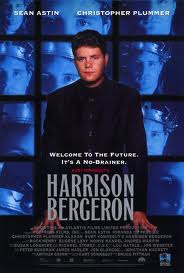
Image result for bird shot shellI heard them scatter across the living room floor, hundreds of tiny metal pellets known as bird-shot. The cats bounced on them, further spreading the little specs to the four corners of the room. I had simply asked Allen to move his weight vest, the one that he wears when he power walks, so that Bonnie and Jared could sit down. But one of the pockets holding the metal  shot had ripped. The bird shot bounced across the floor, rolling under couches and into heat vents. And as Bonnie yelled at her younger brother and Jared ran for the broom, all I could think about was Harrison Bergeron. Harrison Bergeron and the equality of bird shot.

In case you are not familiar with it, Harrison Bergeron is a short story by Kurt Vonnegut, set in a futuristic dystoptia where everyone in the world is finally equal in all ways. No one is smarter or stronger or more talented than anyone else and this miracle of equality is brought about by bags of bird-shot. Those who are judged to be superior in anyway are required by law to wear bags loaded with lead weights, or fixed with headphones which emit ear-splitting sounds, or wear hideous masks to hide beauty. And the smartest and strongest and most beautiful of all the inhabitants of this brave new world is Harrison, the fourteen year old son of George and Hazel, and an escaped convict. It was a story I taught to my sixth grade students a good number of years ago and like many stories, certain lines were implanted forever in my brain.

THE YEAR WAS 2081, and everybody was finally equal (Vonnegut, 1961). And as good as that might sound, the equality Vonnegut describes is not at all the world I want for my children,  particularly for my autistic son. George Bergeron, Harrison's father, is forced to wear a "handicap" of 47 pounds of bird-shot padlocked around his neck because he has been judged to have a superior intellect. And as the little pieces of bird-shot rolled across my floor, an image of my son when  he was young and struggling in school came to my mind. He did not need bags of bird-shot as a handicap.

Equality does not exist. There will always be those who are better at some things, smarter at some things, more athletic at some things. Yes, we were all created equal and our rights as citizens guarantee us the same liberties as others. But we are all unique, little pieces of bird-shot unlike any other. Equality, as Vonnegut points out, does not solve everything:

Some things about living still weren't quite right, though. April for instance, still drove people crazy by not being springtime. And it was in that clammy month that the H-G men took George and Hazel Bergeron's fourteen year-old son, Harrison, away (Vonnegut, 1961). Harrison makes his way to a television studio where a ballet program is being broadcast. George and Hazel are in their home, watching the show, when Harrison bursts into the scene. But their handicaps keep them from being concerned with their son.
Image result for asd
I am always concerned with mine. Allen, quite in keeping with someone who has Asperger's Syndrome-- the highest functioning form on the autism spectrum-- was more concerned about his vest than my floor and the bouncing bird-shot. While Bonnie and Jared did their best to clean up, Allen wanted to know what was to be done with his vest. My mind still occupied with the final scenes of Vonnegut's story, where Harrison has ripped off his handicaps and is dancing with the most beautiful ballerina without her hideous mask, I suggested duck tape, our usual go-to for household emergencies.

"NO!" he loudly declared. "It will ruin the vest. I need you to sew it. That's what I need!"

I tried to be patient. Really. "I can't sew it," I explained. "My sewing machine can't handle fabric that thick."

"Then sew it by hand," he stubbornly insisted. I shook my head. "The material's too tough for that. But maybe we could put the pellets in a new pocket and cut off the old one."

"NO!" Allen shouted. "You are not being helpful." He pounded up the stairs to his room, the vest still oozing bird-shot. Carefully, we picked it up and placed it in a large plastic bag. I heard Allen's door slam.

"He'll  be back," I told the family. We swept up as many of the pesky pellets as we could find. I would, I was quite sure, be picking them up for a long, long time. They would hide in cracks and crevices of the floor, the cushions of the couch, the seams of the baseboards. We got out Scattergories, our go-to family game, and began to play a very unequal game. Some of us were better at certain categories than others. Unlike Harrison and George, we did not need ear radios with high pitched screeches and bags of weight strapped to us. We were, all of us, handicapped in our own ways. Not equal. Not by a long shot.

Eventually , as predicted, Allen came back downstairs. He dragged the vacuum cleaner with him and dutifully set to work on the couch and the floor. Then he murmured a brief apology for his actions and joined us for what proved to be a riotous game complete with the laughter that is bound to happen when people who have different talents and different skills get together. In Vonnegut's world the game would have ended in a tie; in this one, Jared was the clear winner.
Image result for harrison bergeron
It was the next day that Allen came to me and offered another apology. "I said you weren't being helpful," he said. "And I know you were trying to be. So, thanks. I was just worried about my vest."

"I know," I said and gave him a hug. "We've all  got things that bother us."

I am sorry to tell  you that Vonnegut's tale ends in tragedy. While Harrison and the lovely ballerina dance for a while and make the audience awe at their combined beauty, they are both ultimately shot and killed. In 2081, equality is  more important than humanity. George and Hazel, equal but deficit, do not even mourn his passing.

Allen, God bless him, is different than his brother and sister. He is different than me or his dad. He has, as we all do, his own bags of bird-shot, his own handicaps. He also has his own talents. As I continue to parent this now-adult through the many nuances of autism, I need to be more concerned with equity than equality. Allen's needs are different than those of his siblings.

If everyone is equal, if everyone is ordinary. then the extraordinary is out of reach.

And each time I kick another piece of bird-shot across the living room, I will remember it. Allen is, in his own way, extraordinary.

Monday, June 6, 2016

Voices from the Edge: If I Had a Hammer

If I had a hammer,
I'd hammer in the morning,
I'd hammer in the evening,
All over this land,


Ever since Allen had put on a new doorknob two weeks ago--all by himself, I might add--the front door had not shut properly. Every night, he slammed and banged to get the door to shut and lock, and every morning it took all my strength to pull it open. But it wasn't until Friday that I realized the doorframe had pulled away from the porch wall; all of our banging and tugging was only pushing the frame farther away from the supporting wall.

"We need a hammer," I told Allen. "So we can pound the frame back in place."

He thought for a moment and I, with the wisdom gained from years of parenting this adult who lives on the upper ends of the autism spectrum, waited. And waited. "Well, maybe," he said. "I'll see if I can find the hammer."

Progress. We have a variety of tools, but I have given up on bringing any order to the basement while Allen works on his robot project, so tools that I need frequently--such as hammers and screwdrivers--are kept in the bottom drawer of the file cabinet. It wasn't long before Allen returned with the smallest hammer he could possibly find, a ball peen probably snatched from his metal work downstairs.

"I really think it's too small," I said. "Nah," he said and shrugged. "A hammer's a hammer."

Okay. I guess. So Allen and I went outside and I showed him just where he needed to pound the doorframe back into place. He gave it a few whacks. Nothing happened.


"Harder," I said. "Put some muscle into it!" Again, he gave it a few whacks. Nothing.

"Not going to work," my son told me. " If I hammer any harder, the top of the frame will break. See?" and he points to the top where I can see absolutely no discernible cracks. "You'll have to hire someone," he said sadly.

I'd hammer out danger,
I'd hammer out a warning,


Once Allen has his mind made up, it is very difficult to change. But I was determined to try. Anyone who knows me knows that I really hate to hire someone to do something that Allen or I can do ourselves. My father, a whiz with any hand tool known to man, taught me to change the oil and the tires on a car, rewire an outlet, and hammer without hitting my thumbs.

"Come on," I told my son. "We just need a bigger hammer."

He hesitated. "Well, there is my sledgehammer. But it will probably break the door. Then you'll really be mad! Sorry." and with that he was off to the basement, where the various parts of his robot currently live.

I studied the situation a few more minutes. I wasn't really strong enough to push the frame back in myself, but a sledgehammer packs a wallop. I'd last seen it on the back deck. Resolutely, I dragged it around to the front. If I could manage to lift it, it just might work.

And it did. It took a few whacks and a few tries before I hit my mark, but I accomplished the task and the frame was solidly back in place. I wished, not for the first time since Ron's car accident, that I had a husband that could do these things and didn't need to figure out so many things on my own. I wished there was someone around to be a mentor to my son, someone to show him the things a dad should teach a son. But, at the same time, I was grateful to my dad who'd taught me basic home maintenance skills, and my youngest son who did his best to help when he could.

The frame was in place and I was preparing to drag the sledge hammer around back when Allen reappeared.

"I thought it over," he said. "And I think you're right. We just need a bigger hammer." Allen's delayed response is not at all unusual for those on the spectrum. Since his brain has developed differently, the cells are packed tighter and the stems are shorter. It takes longer for him to process things.

"Too late," I told him  and was sorry I hadn't waited a while longer. I did a Vanna White pose, pointing out the fixed doorframe.

He spied the sledgehammer at my feet. "You used my sledgehammer?"

I nodded. "Yep. And it worked." For a moment, I could not read his expression. Was he upset I'd gone ahead without him? Mad I'd used his tool?

Finally, he grinned his special Allen smile. "So," he said, "since you used MY sledgehammer"--and the emphasis is his--"it's like I fixed it. And I want the credit for it." With that he easily hefted the item and carried it away.

I'd hammer out the love between
My brother and my sister
Ah uh, all over the world.

If you are keeping score here--and I guess Allen is--it's five him, three me. But at least my door is fixed. And Allen, who maybe only had a minor contribution to the event, has defied the odds by being in the minority--only 6%, according to recent government data--of autistic adults who hold a fulltime  job.


Heck, let's put another one in the Alen column. And maybe one for me as well. We're doing okay.