Showing posts with label handicaps. Show all posts

Thursday, April 2, 2020

Unexpected Blessings: Voices from the edge

Unexpected Blessings: Peoples, Sandra: 9780764231667: Amazon.com ...My son is in a hurry to get the marketing done because I have promised him Wendy's for supper. He races around Save a Lot, gathering the things we get every week: pizza, chips, soda. I take a more leisurely approach, pushing my cart up and down every aisle as I peruse my list.

"Do you know where the baking powder is?" asks an elderly woman in the baking aisle.

"Right here," I say and reach up on the top shelf to get the item. I hand it to her.

"Don't know why they keep changing things around," she grumbles and I just smile. Just then, I see Allen barreling towards us, his arms full of the microwave sandwiches he likes. He dumps them unceremoniously into the cart and rushes on past. My shopping companion holds her hand to her chest.

"Mercy!" she says. "What's wrong with him?"

I turn to look at my son's retreating form, trying to see what she sees. To me he is just my youngest child, an adult on the autism spectrum. But I know the wild hair--getting Allen to comb it is an issue most days--and the brusque attitude is often seen as others to be strange. Add to that Allen's tall stature--all 6 feet 6 inches of him--and some people do feel threatened by him.

Autism awareness day puzzles shape ribbon Vector ImageBut I know Allen. I know him to be gentle and kind and often confused by the world. I turn and face the woman next to me. "That's my son," I say gently. "He has autism."

"Mercy!" she declares again. "You poor thing!" she pats my arm. "To have a mental child like that!"

I take a deep breath. I could smile and walk on. But even though it might fall on deaf ears, I make a decision to educate. I am, after all, a teacher as well as a mother. "His brain works differently than some," I tell the woman. "There is nothing wrong with his brain. It just takes him longer to understand things. And right now," I lean in towards her conspiratorially, "his mind is focused on getting a burger at Wendy's for supper."

Wendy's breakfast: Fast food chain hiring 20,000 new employees"Still," says the woman, her voice a bit unsure now," must be a burden on you."

"Not at all," I say. "Allen and I understand each other. We have a routine. He gets the things we need every week." Just then Allen roars past us again, adding a container of cat litter and a box of trash bags to the cart. He barely pauses as he rounds the corner.

The woman pats my arm again. "Bless your heart," she says.

"You know" I tell her as I begin to move my cart away from hers, " many people are autistic. You might even know some. One in 54 people has some form."

"Really?" She seems surprised. "Are they all like..." she points, "your son?"

I shake my head. "No. Some cannot talk. Some function so well you might not even know they were autistic." I move down the aisle. "Have a nice day," I say.

What's wrong with him? I am sorry to say that I hear that question a lot. Allen doesn't always look like others, or act like others. It takes an intense amount of effort on his part to behave the way society expects him to. His father's funeral a few months ago, for example, required Allen to expend enormous effort to stand by my side and shake hands. And helping Allen process his grief at his father's loss is an ongoing journey. "Autism grief is not neurotypical grief" is a phrase that is now engraved into my brain.

When Allen was born, he seemed to be a healthy baby boy. As the youngest of our three, he was content with very little; he seldom cried or fussed. His older brother and sister made up games with him in the starring role. It wasn't until Allen was 3 that we learned he had some developmental delays. Ron and I needed to help Allen in different ways than we had helped Dennis and Bonnie. He needed different methods of educations. And long with the developmental delays were some physical problems: A blood condition that produces too much ammonia, and an inability to produce salt. he gets dizzy spells sometimes. The diagnosis of autism did not come until adulthood.


Wear BLUE April 2nd | World autism awareness day, Autism dayDid we ask why? I know Ron did. I know that the thought of a disabled child was troubling. Me? I was his mother. No matter what.

But the woman in the market is not unlike the people in John 9 who asked of Jesus, "Who sinned, Rabbi, his man or his parents that he was born blind?" (vs 2). Jesus responded, "Neither this man nor his parents sinned but this happened so that the works of God might be displayed in him."

Allen, and others who reside somewhere on the spectrum of autism or are differently abled, is a work of God. Others may not see it, but I know the gentleness that resides within my giant son. Each afternoon, he makes me a cup of tea so I can relax before dinner. Each night, he carefully double-checks the locks on the doors to keep us safe.

I am halfway up the frozen food aisle when I see Allen again. He grins at me and places a package of Tastykakes into the cart. "Almost done?" he asks. Now that the task is almost accomplished, he can slow down. Many who are on the spectrum, like him, can only handle one thing at a time.

"Almost," I say and put a few bags of vegetables into the cart. Just then I spy the woman from the baking aisle coming towards me.

"Don't know why they put the bread up so high," she grumbles.

Allen strides over to her. "Which one do you want?" he asks. "White or wheat?"

"What?" She is clearly startled. She steps back and eyes him warily. His hair is still wild, but he is smiling now. "Oh, wheat," she says.

Allen grabs the bag and hands it to her. "That's what my mom always gets," he tells her and moves back towards me. The woman is still standing there, holding the bag in her hand, looking at Allen as we walk towards the cash registers.

Works of God come in many forms. Some of them are unexpected. Some of them are a tall young man with wild hair and a kind smile.


Tuesday, July 5, 2016

Voices from the Edge: The Equality of Birdshot

Image result for bird shot shellI heard them scatter across the living room floor, hundreds of tiny metal pellets known as bird-shot. The cats bounced on them, further spreading the little specs to the four corners of the room. I had simply asked Allen to move his weight vest, the one that he wears when he power walks, so that Bonnie and Jared could sit down. But one of the pockets holding the metal  shot had ripped. The bird shot bounced across the floor, rolling under couches and into heat vents. And as Bonnie yelled at her younger brother and Jared ran for the broom, all I could think about was Harrison Bergeron. Harrison Bergeron and the equality of bird shot.

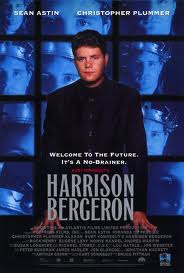
In case you are not familiar with it, Harrison Bergeron is a short story by Kurt Vonnegut, set in a futuristic dystoptia where everyone in the world is finally equal in all ways. No one is smarter or stronger or more talented than anyone else and this miracle of equality is brought about by bags of bird-shot. Those who are judged to be superior in anyway are required by law to wear bags loaded with lead weights, or fixed with headphones which emit ear-splitting sounds, or wear hideous masks to hide beauty. And the smartest and strongest and most beautiful of all the inhabitants of this brave new world is Harrison, the fourteen year old son of George and Hazel, and an escaped convict. It was a story I taught to my sixth grade students a good number of years ago and like many stories, certain lines were implanted forever in my brain.

THE YEAR WAS 2081, and everybody was finally equal (Vonnegut, 1961). And as good as that might sound, the equality Vonnegut describes is not at all the world I want for my children,  particularly for my autistic son. George Bergeron, Harrison's father, is forced to wear a "handicap" of 47 pounds of bird-shot padlocked around his neck because he has been judged to have a superior intellect. And as the little pieces of bird-shot rolled across my floor, an image of my son when  he was young and struggling in school came to my mind. He did not need bags of bird-shot as a handicap.

Equality does not exist. There will always be those who are better at some things, smarter at some things, more athletic at some things. Yes, we were all created equal and our rights as citizens guarantee us the same liberties as others. But we are all unique, little pieces of bird-shot unlike any other. Equality, as Vonnegut points out, does not solve everything:

Some things about living still weren't quite right, though. April for instance, still drove people crazy by not being springtime. And it was in that clammy month that the H-G men took George and Hazel Bergeron's fourteen year-old son, Harrison, away (Vonnegut, 1961). Harrison makes his way to a television studio where a ballet program is being broadcast. George and Hazel are in their home, watching the show, when Harrison bursts into the scene. But their handicaps keep them from being concerned with their son.
Image result for asd
I am always concerned with mine. Allen, quite in keeping with someone who has Asperger's Syndrome-- the highest functioning form on the autism spectrum-- was more concerned about his vest than my floor and the bouncing bird-shot. While Bonnie and Jared did their best to clean up, Allen wanted to know what was to be done with his vest. My mind still occupied with the final scenes of Vonnegut's story, where Harrison has ripped off his handicaps and is dancing with the most beautiful ballerina without her hideous mask, I suggested duck tape, our usual go-to for household emergencies.

"NO!" he loudly declared. "It will ruin the vest. I need you to sew it. That's what I need!"

I tried to be patient. Really. "I can't sew it," I explained. "My sewing machine can't handle fabric that thick."

"Then sew it by hand," he stubbornly insisted. I shook my head. "The material's too tough for that. But maybe we could put the pellets in a new pocket and cut off the old one."

"NO!" Allen shouted. "You are not being helpful." He pounded up the stairs to his room, the vest still oozing bird-shot. Carefully, we picked it up and placed it in a large plastic bag. I heard Allen's door slam.

"He'll  be back," I told the family. We swept up as many of the pesky pellets as we could find. I would, I was quite sure, be picking them up for a long, long time. They would hide in cracks and crevices of the floor, the cushions of the couch, the seams of the baseboards. We got out Scattergories, our go-to family game, and began to play a very unequal game. Some of us were better at certain categories than others. Unlike Harrison and George, we did not need ear radios with high pitched screeches and bags of weight strapped to us. We were, all of us, handicapped in our own ways. Not equal. Not by a long shot.

Eventually , as predicted, Allen came back downstairs. He dragged the vacuum cleaner with him and dutifully set to work on the couch and the floor. Then he murmured a brief apology for his actions and joined us for what proved to be a riotous game complete with the laughter that is bound to happen when people who have different talents and different skills get together. In Vonnegut's world the game would have ended in a tie; in this one, Jared was the clear winner.
Image result for harrison bergeron
It was the next day that Allen came to me and offered another apology. "I said you weren't being helpful," he said. "And I know you were trying to be. So, thanks. I was just worried about my vest."

"I know," I said and gave him a hug. "We've all  got things that bother us."

I am sorry to tell  you that Vonnegut's tale ends in tragedy. While Harrison and the lovely ballerina dance for a while and make the audience awe at their combined beauty, they are both ultimately shot and killed. In 2081, equality is  more important than humanity. George and Hazel, equal but deficit, do not even mourn his passing.

Allen, God bless him, is different than his brother and sister. He is different than me or his dad. He has, as we all do, his own bags of bird-shot, his own handicaps. He also has his own talents. As I continue to parent this now-adult through the many nuances of autism, I need to be more concerned with equity than equality. Allen's needs are different than those of his siblings.

If everyone is equal, if everyone is ordinary. then the extraordinary is out of reach.

And each time I kick another piece of bird-shot across the living room, I will remember it. Allen is, in his own way, extraordinary.