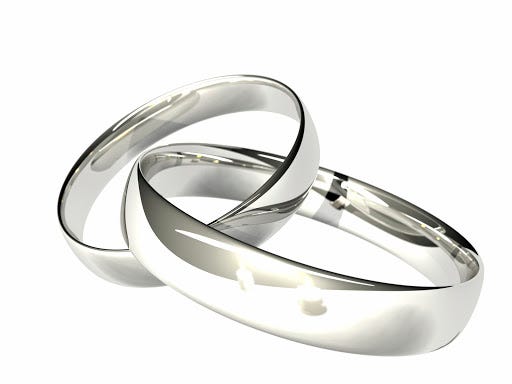
Ring-a small band, usually of precious metal, worn on a finger and often a symbol of love
Its weight is slight, almost insignificant as it rests in the palm of my hand, but its strength has been enduring. I recall the smooth feel of it when Ron slipped it on my finger oh, so, many years ago, at the beginning of its journey.
We have arrived at the end.
I consider the circle of silver carefully, marveling at the births and vacations and graduations and marriages it has seen, the injuries and surgeries and hospitalizations that might have dulled its shine but didn’t.
Not even death.
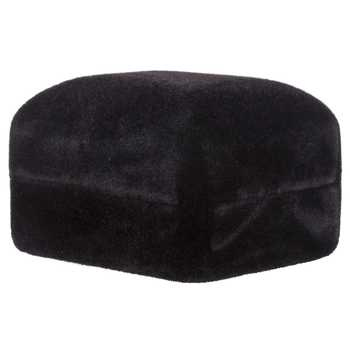
I pick up the square black velvet box from my dresser and open it slowly. Inside is the mate to the ring in my hand, larger and bulkier, the ring Ron’s painfully swollen finger could not endure for the last 18 months of his life.
“I’m keeping your ring,” I whispered to him on that final day. “I’ll keep it safe because you are still my husband.”
The two rings lay side by side on my palm now: the smaller one strong enough to bear the weight of care-giving and loss, the larger one strong enough to bear the weight of pain and sorrow.
A tear slides down my cheek. I am making a decision today, but it is not irrevocable. This small unbroken ring of silver has encircled my finger for the last 20 months while Ron’s has slumbered in the black box.
I can put it back on if I need it.
Tenderly, I slip the two rings—together—into the square box and close the lid quietly, whispering another promise.
“I am no less committed to you now than on the day these rings were new.”
For a moment, I feel the ache of emptiness on my finger, the pain of loss that is always in my heart. I take a deep breath and pick up another ring, also silver, with three small diamonds on its band, the ring Ron gave me on one of the last birthdays we had together.
Past. Present. Future.
Ron is now in my past and for the moment, I stand in the present alone while he waits in heaven, whole and healthy. But he is also in my future.
I will see him again.
I slip the band with the diamonds onto my hand and stow the box with the two silver wedding rings in my jewelry case.
"To them I will give a new name within my temple and its walls a memorial and a name better than sons and daughter, I will give them an everlasting name that will endure forever." Isiah 56:5
I am wrung out with emotion. Today, eighteen months after my husband's death, I have moved our queen-size bed back into the spot beneath the double windows where it had been until the day he died. On that awful night, I'd shoved his side of the bed against the wall, piling pillows around it to fill the empty space. I slept on my side, facing away from the void.
I am stronger now, I think. Ready to move the bed back. I have found a new life for myself and my autistic son; I have written sixteen chapters of a book I hope will impact the way people view autism and grief; I have dared to envision a life without Ron.
But after I move the bed back and rearrange the pillows, I collapse onto the bed and cry. I have moved into a life without my husband. The knowledge holds both joy and sorrow. When my tears are spent, I get up and look at the room we have shared for 44 years. It is my room now.
Maybe I'll paint it.
Evening comes. Allen and I eat and play a board game, a new routine in our life of two. We watch an Avengers movie while I knit. We talk easily of Ron, how he cheated at Monopoly and loved Iron Man, how his smile was slightly crooked and he yelled at the television set. Allen's acceptance of Ron's death took time and patience. Ron is not forgotten. I think of the Egyptian proverb: You are not dead as long as someone remembers your name.
We remember.
I have said goodnight to my son; he gives me the rare hug he saves for bedtime and follows me into my room where he plops down on Ron's side of the bed.
"You moved it back."
"It was time," I say and he nods. He grabs a pillow from Ron's side and holds it to his face.
"It still smells a little like Dad."
"A little," I agree. I have washed the pillow and enveloped it in a new case, but sometimes I think I still detect Ron's lingering scent.
"Can I sleep with it tonight?"
I shrug. "I guess. Something wrong with your pillow?"
"No," he says. "I just sort of want to be close to Poppa tonight. I thought it would be nice to sleep with his pillow."
"Alright."
Happily, he gathers the pillow in his arm and squeezes it, then rises from the bed and walks towards the door.
"Allen," I say, "you've never called Dad 'Poppa' before. Why now?
He turns back to me, this man child who only knew an ill father. "Well, Mom," he says, "Dad has a new life now. He's not old and sick anymore because God gave him a new body and took him to Heaven." He grins. "And I thought Dad's new life deserved a new name."
The LORD will surely comfort Zion and will look with compassion on all her ruins; he will make her deserts like Eden, her wastelands like the garden of the LORD. Joy and gladness will be found in her, thanksgiving and the sound of singing
Isaiah 51:3
The dream felt real to me. The garden grew up around us, scarlet rhododendrons and sunshine yellow daffodils pushing their way through the cracks in the pavement beneath our feet. I breathed in the flowery fragrances of the blooms, marveling at the spring-like abundance so late in the autumn.
I felt a light touch on my arm and smiled at my husband. His image was wavy, translucent. "You did this," he said and waved his hand at the abundance around us. His silver wedding ring--nestled in my jewelry box for the last 15 months--gleamed in the sun.
"I'm no gardener," I said and shook my head. "Everyone knows I make plants die."
Ron smiled gently. "Yes, you are. You've made beauty for me, for the kids, for your students, for your readers. You've taken what was hard and painful and made something beautiful from it." He stamped a strong foot onto the pavement. "You've done what very few people could do."
I took a deep breath. "I did what I had to do."
Ron took my hand. His hair, fully gray the last time I saw him in his casket, was the blue-black of his twenties. "That's just it. You didn't have to." His voice became a gentle whisper. "I know how awful it was, how exhausting."
"For both of us," I said. I noticed that his form was beginning to fade, the lovely blossoms of my garden clearly visible through his frame. "Stay," I said softly.
"I can't," he said. "If I was here," and he turned his head, taking in the abundance around us, "none of this would have happened. I just wanted to tell you, well, I knew you'd be okay. When I had to leave, I knew you'd make a new and wonderful life for yourself. I knew you'd help the kids to move on." He plucked a single pink rose from a bush thar had sprung up next to him. No thorn pricked his hand. He held it beneath his nose for a moment, his clear lungs breathing in the fragrance. "It's your turn now," he said and handed the rose to me.
I took it and touched its velvety petals. "It's lovely," I said.
"Just as your life will be," Ron said. "Your long life. You have lots to do." He blew a kiss towards me. "I'm so proud of you." He melted into the garden.
And I held onto the rose, breathing in the heady fragrance of my husband's love.
But Mary treasured all these things and pondered them in her heart. Luke 2:19
I decide on coral and teal. If I cannot go to my happy place at the beach this year, I tell myself, I will bring the beach to me, beachy colors that will calm my soul every time I take a shower. Happily, I order a shower curtain and a window shade online. While I wait for the packages to arrive, I gather other items: new peach and white flowers for the washing pitcher that belonged to my grandmother, the little jar of seashells we bought in Bermuda, a pink candle I find in the downstairs cabinet. Amazon delivers on Thursday and on Friday, armed with cleaning supplies and a trash bag, I head up to the hall bathroom to refresh my soul with happy things.
I am delighted with the colors, glad that the light gray walls allow me to change the decor without major expense. I have even indulged in new curtain hooks in the shapes of seashells and starfish. I delve into the top drawer of the cabinet under the window. Time to clear out the clutter! I toss empty shampoo bottles, old toothbrushes, and a dried up jar of Vaseline with happy abandon. I reach into the very back of the cabinet and pull out a can.
And I stop and sink to the teal colored rug on the floor of the bathroom, holding a can of Barbisol shaving cream in my hand, and cry.
This was Ron's. The only kind he ever used, the kind that was put into his Christmas stocking by one of the kids every year and given on each Father's Day along with Old Spice aftershave. The can still emits the faint, clean scent of my late husband. Quickly, the memories come pouring into my mind: Ron on our honeymoon, carefully shaving while I watched, fascinated by the contours on my new husband's face. Ron on our trip to Jamaica, needing to buy a different brand of shaving cream at the gift shop--at an outrageous price--because he forgot to pack it. I probably said a few unkind words. Ron sitting in his wheelchair, no longer able to hold the razor, giving me instructions while I lathered his face and prayed I would not cut him. Ron in his hospital bed, the nursing aide using an electric razor to trim his bushy gray beard.
Memories, psychology tells us, allow us to relive special moments in our lives, both good and bad (Psychology Today). And God designed memories so we could relive not only the grand moments of our lives, but the small and intimate details that make up the years, the relationships. A marriage.
There on the bathroom rug, the shaving cream in my hand, I recall Luke 2:19, "But Mary treasured all these things and pondered them in her heart." I want to believe that these small moments--Jesus in his infancy and childhood, ordinary moments to anyone but a mother--are what gave her the courage she needed to bide him farewell.
It has been a year and a little since I bide Ron farewell. Not forever, but for now. I am learning to negotiate the path one step at a time, making a new life for myself and my autistic son, allowing myself to cry over a can of shaving cream and store up a few more treasures in my heart.
It was a long battle for us, an uphill battle of many years and many illnesses. We learned in those years, Ron and I, to treasure the small moments of peace: a shared meal from a hospital tray, a day without surgery, a cup of tea after work drunk at his bedside. God was faithful on our upward climb. The road was often dark and treacherous, the path unknown.
The path led Ron to Heaven.
I walk alone now, on a new path of widowhood. I have not "moved on" from Ron, but I have "moved forward," twisting those many years of care taking--what was often back-breaking and soul-crushing--into my life. I hang coral colored curtains and seashell curtain rings. I cry over small things.
God is still faithful.
The tears are a healing balm. Soon I am able to get up from the rug in the middle of the bathroom floor and toss the empty can into the trash bag. I hang my new curtains, place my little memories around the room. I touch the seashell shaped curtain hooks one by one, each one a memory of a happy day.
My husband is still here, in each action I take, each thought I think. Like the coral and the teal colors I have chosen, he calms my soul.
Like you've never been before The life you knew In a thousand pieces on the floor
"Your husband's heart is very damaged," said Dr. Hoffman. She stood next to our chairs in the trauma waiting room, still wearing a blue surgical gown. "His aorta was crushed by the steering wheel. And he's sustained a lot of other damage in his chest and pelvis. But, he's survived the surgery. There may be other complications later on, but for now he is stable."
My daughter and I were numb after eight hours spent in molded plastic chairs, eight hours of twisting our hands and praying. During the evening and early morning hours, friends and church members had stopped by to pray and wait with us. Now, at 2AM, it was just Bonnie and me and our minister.
"You can see him for a moment," said Dr. Hoffman. "Then you all need to go get some sleep. Don't set the alarm for work or school. Just sleep. We'll call you if anything happens."
Ron lay on the stretcher in the recovery room, still and gray, wires and tubes connected everywhere to his body. A screen above showed his heart beat in glowing green. I touched his right shoulder, one of the few places on his body without an electrode. "Stay with me," I whispered to him. "Tell your heart to keep beating."
And words fall short in times like these When this world drives you to your knees You think you're never gonna get back To the you that used to be
Tell your heart to beat again
Close your eyes and breathe it in
"Is he still alive?" asked the voice on the other end of the phone. "I just got the message you left. Mom, tell me, is Dad still alive?"
Bonnie, Allen, and I had huddled together in my bed for a few hours, trying to sleep away some of the fears we were feeling. One of us would drift off for a few moments, but inevitably we would wake up and grab for each other. Thoughts ran through my head: What now? How would we get through this? Could I be strong enough for Ron, for our children?
Tears streamed down my face as I responded to my son, away at college. "Yes," I said. "Dad's still alive. When we left him at a couple hours ago, his heart was still beating."
Let the shadows fall away
Step into the light of grace
Yesterday's a closing door You don't live there anymore Say goodbye to where you've been And tell your heart to beat again.
"The surgery on his pancreas was successful," said Dr. Harbison. "He'll be on a feeding tube for a while, and gradually we'll reintroduce solid foods. But his heart has become enlarged. It's not working at full capacity. He'll spend some time in the telemetry unit, but I think he is going to need a pace-maker. We'll watch him for a few days until he's stronger."
I made notes on the pad I kept in my purse as he talked. Terms once foreign to me--pancreas, spleen, telemetry- were now part of my everyday vocabulary. "I'm assuming you will give him a diet to follow when he's released, things that are easy to digest and that will keep his blood sugar level. When can I see him?"
"In about half an hour," he said. "We've had some trouble bringing him out of the anesthesia."
"It always happens," I said.
He paused for a moment and checked Ron's chart. "I see this is his--fourth surgery in the last year? This must be hard on you."
"It is," I agreed. "But we're a strong family. The kids and I figure it out as we go along." I smiled as I put the notebook back in my purse. "As long as his heart keeps beating, we'll keep fighting."
Beginning
Just let that word wash over you
It's alright now Love's healing hands have pulled you through So get back up, take step one Leave the darkness, feel the sun 'Cause your story's far from over And your journey's just begun
"Your pulse is very weak. Mr. Cobourn, I think you're going into A-fib. Are you with me? Stay with me!" shouted the nurse.
I grabbed Ron's hand. "Come on, honey. Keep breathing." I turned to the nurse who was busily raising the bars
on the stretcher Ron laid on. "Shall we call 911?" I asked her. "Do we need the paddles? Is his pace maker working?"
"It will be quicker to run him across the street to Temple," she said. "I'll push. Go hold the elevator!"
I picked up Ron's things and ran down the hallway of the medical building on Broad Street, determined to stop traffic if I had to in order to get Ron into the Emergency Room across the street. "I'll call them that we're on our way!" I said as I furiously pushed the button for the elevator. The nurse arrived, breathless with her exertion, and the doors slid open. I leaned over my groggy husband and whispered in his ear, "Tell your heart to keep beating. Tell it not to stop."
Tell your heart to beat again
Close your eyes and breathe it in
Let the shadows fall away Step into the light of grace
"It's his heart" said the voice on my cell phone. "As you know, it's terribly scarred from so many surgeries and infections. And it's only working at 25% capacity. Dr. Araidne needs to do an ablation but since you have medical power of attorney..."
"I know," I said as I opened up my desk drawer and picked up my purse. My elementary students were out on the playground and the Reading lesson was on the board.
"How soon can you be here?"
I checked the clock on the wall. " Maybe 30 minutes," I said. "I'm just up on Academy Road. I can get to Hahnemann pretty quickly."
"Okay. We'll let the surgeon know."
I grabbed my purse and locked the door. I would run by the office and tell the secretary I was leaving for the hospital; my reading students would have to stay in their classroom. Quickly, I strode over to the parking lot and got into my car. "Tell your heart to keep beating," I whispered to my husband. "Just a little while longer."
Let every heartbreak And every scar Be a picture that reminds you Who has carried you this far
"We did everything we could," said the EMT. "There is nothing else we can do. His heart just..stopped. Between one beat and the next." He laid a hand on my arm. "I wish we could have done more."
I took a deep breath. "He's been through a lot. Too many hospitalizations. Too many surgeries. Nineteen years of too much for one man to deal with." I let the tears fall from my face. "He stayed as long as he could. He kept his heart beating for us."
The EMT bent to put the instruments back into his bag. "The medical examiner will be along later. But I think cause of death is obvious." He straightened up. "You took good care of him, Mrs. Cobourn. Never doubt that." He sighed. "Frankly, he shouldn't have lived this long. He did because he loved you."
'Cause love sees farther than you ever could In this moment heaven's working Everything for your good
"Dad's okay now," I said to my three children, huddled together on the deck out back while the EMT's finished up. "He's not in pain anymore. I promised him...I promised him we would all be okay. I promised him we would move on with our lives. I promised him we would always remember him."
Tell your heart to beat again
Close your eyes and breathe it in
Let the shadows fall away
"Good-bye," I whispered as I leaned over the casket. "It will take some time, I know. But I want you to know I will be okay. Your love will always be part of me. My heart will beat for you."
i thank You God for most this amazing day:for the leaping greenly spirits of trees and a blue true dream of sky;and for everything which is natural which is infinite which is yes
(i who have died am alive again today, and this is the sun's birthday;this is the birth day of life and of love and wings:and of the gay great happening illimitably earth)
how should tasting touching hearing seeing breathing any—lifted from the no of allnothing—human merely being doubt unimaginable You?
(now the ears of my ears awake and now the eyes of my eyes are opened)
ee cummings
They are always in bloom on Mother's Day. I stand outside on my deck early this morning, a knitted shawl around my shoulders, a mug of tea in my hands, and I marvel at the white daffodils, their yellow faces pointing up to the sun, that mange to bloom every year despite my neglect. Unlike my grandmother, who planted them by the fence on the Mother's Day after Bonnie was born, I do not have a green thumb. For years I told my husband and children never to give me plants for Mother's Day because it was, for anything blooming in a pot, a death sentence.
But my grandmother could make flowers bloom from concrete. The day I brought my infant daughter home was a Mother's Day and my parents and grandparents descended on my house with cake and dinner and a pot of daffodils. They were, Grandmom told me, "Narcissus Ice Follies". The name meant nothing to me. But now, forty-one years later, I am still greeted by their cheerful faces, the seedlings from the original plant having kept up the heritage of their parent.
I turn to go back inside where it is warmer, my head full of thoughts of Mother's Day past. There is no smell of burnt toast and eggs this morning, no dishes piled in the sink from Ron's attempt to make me breakfast in bed. There is no ill-chosen gift in the wrong size or the wrong color waiting to be opened on the dining room table, no card he would have forgotten to sign still in the Walmart bag. Allen --although he has promised me doughnuts this morning--is still asleep. Darling daughter--who knows me well--has sent me a T-shirt proclaiming, "It's what I do! I read and I know things!" and some brightly colored yarn. Perhaps Dennis, oldest son, will call later on.
It is my first Mother's Day without Ron. I am missing the smell of burnt toast more than I could have imagined. I am trying to remember what he gave me last year. "Something one of the aids would have gotten," my daughter has reminded me. Ron was long past being able to leave the house by then. I think about sorting through my jewelry box; was it the turquoise earrings Veronica had ordered? Or the butterfly bracelet Phyllis got?
The sight of the daffodils stops me. "White daffodils" my grandmother said before she took the spade she had brought with her and went to plant them," mean rebirth. They are a good flower for your new baby."
Rebirth. We are in the midst of a pandemic, with people sheltering in their houses and most of us working from home. We do not know how long it will last. But we have hope that one day soon, the bans on gathering will be lifted. We will meet again for worship and family celebrations. I think of the words of Isaiah 43:2: "When thou passest through the waters, I will be with me; and through the rivers, they shall not overflow thee; when thou walkest through the fire, thou wilt not be burnt; neither shall the flame kindle upon thee." God is still with us.
God is still with me. Ron has been reborn into a new and eternal life. His heart, so damaged by infections and surgeries, was a good heart. A loving heart. A kind heart. He has left his heart with me.
And I, too, am being reborn. No longer the care-giver to a critically ill man, there are new paths for me to walk. I watch the daffodils lift up their trumpet shaped heads and proclaim, "This is YES!" Yes, to life, yes to beauty, yes to what lies ahead, lifted from the no of sickness and death.
The ears of my ears are awake. The eyes of my eyes are open.
My daughter and I have spent a lovely two hours on the beach at Rehoboth, stowed the umbrella, chairs, and towels into the back of my SUV, and are now strolling along the boardwalk. Actually, she is strolling and I am limping. My flip-flops, perfect for the sand and surf, are not great at walking on wood and concrete. Quickly, I have developed a blister on my right foot.
"Let's get you new shoes!" announces Bonnie, so we slip into the air-conditioned quiet of the Kite Shop. Among the flags and Frisbees and beach toys we find a pair of slip-on sandals with some cushion to them. She insists I throw out the flattened flip-flops from last year. Or maybe they're from the year before.
"You need to buy yourself something new once in a while," she says as we continue our walk. I am aware that our time, as always, is limited. This has just been a quick overnight trip to visit my 91-year-old father. This evening we will drive home again where she and her husband will go look at some houses tomorrow, hopeful to move, and I will return to Allen and Ron. "You do everything for Dad and so much for Allen. You need to take care of you."
I shrug. "There is never time," I say. "Or money." I sigh. "Your dad requires a lot of both."
Despite the July heat, she takes my arm and snuggles up to me. "Someday there will be time," she says and I nod, fighting back tears. The older kids and I had realized a few months back that, despite our best efforts, countless surgeries, and nursing help, Ron was not getting better. We didn't talk about it, but the inevitable end was in sight.
I need to sit down for a moment. The blister on my foot is painful and the sand is rubbing into it. We choose a bench facing the ocean and let the salt breeze cool us. I shake my head. "I never thought--after the car accident--that your dad would be ill this long. I thought he'd get better." I gulp. "I don't know how long I can do it."
She puts her head against my shoulder and for long moments we sit there, facing the ocean, reluctant to move on. "You will do it," she says, "as long as you need to."
She was, I knew, right. God had provided me with whatever strength I needed in the last 19 years. God alone knew when the time would be right to call Ron home to Him. My part was to continue doing all I could and look to God to shore up my flagging energy. "Guess we should be heading back to Pop Pop's," I say after a few more precious moments. I limp back up the boardwalk, the blister on my foot becoming more aggravated, and we head back to my father's.
After dinner with Dad and Peg and a phone call home to Allen, who reports he went to WaWa to get Ron a soda and a pretzel, my daughter and I throw our overnight bags into the car and head on home. My foot is hurting so Bonnie drives and around Smyrna we stop at a Gas and Go for a first-aid kit of band-aids and Neosporin. Bonnie insists I buy two.
"Keep one in your purse," she says. "It might take a while for your foot to heal. Healing can take time."
If you've read my blogs, if you're my friend, or if you go to my church, you know how this day ended. You know that Bonnie and I arrived home around 9:15, walked into the house with a cheery, "We're home!" and found that God--infinitely wise and merciful--had chosen to call Ron to Himself. Phone calls were made, EMT's and police and friends arrived, Bonnie's husband and older brother and his girlfriend came. Allen, who lives on the edge of the autism spectrum, stayed quiet and withdrawn.
My foot still hurt. Throughout the week, the funeral, the burial, the luncheon, I limped, the blister gained on the boardwalk at Rehoboth a daily reminder of my more intense pain. I used the band-aids and the Neosporin Bonnie had insisted I buy. I threw myself into tidying up end-of-life issues, dispersing medical equipment, sorting out clothing, taking unused prescriptions to the pharmacy. I spent weeks helping Allen come to an acceptance of his father's loss.
Slowly, my foot improved. By the time I returned to teach English as a Second Language at an urban high school in September, it no longer bothered me. It had taken the time to heal.
But perhaps I hadn't given other things enough time to heal.
If you're reading this now, it's probably because for the first time in a loooonnnnngggg time, you're not overwhelmingly busy. According to an article in Forbes (Pontefract, 2018), Americans live in the age of "freneticism"--always busy, always on. This, says a survey from StressPulseSM (2017) leads to being stressed and stress decreases our satisfaction with life. And also interferes with our ability to be creative. Writer Kimberly Hines (2018) notes that the tendency of Americans to multi-task is not the great tool we think it is but leads to "shoddy work, mismanaged time, stress, and forgetfulness."
Back in January of 2020--pre COVID-19--the Center for American Progress reported that America was the most over-worked of developed nations with no maximum length of a work week, fewer paid sick days, no paid parental leave nationally, and only 13 days of paid vacation per year.
How times have changed. The corona-virus pandemic has brought all of us extremely busy bees to a grinding halt. And while many people are tragically dying, and healthcare workers are pushed to the limit, and a lot of people are out of work, and toilet paper is the new gold standard, I'm not sure there isn't something positive to be said for our mandated need to slow our roll. Maybe we all desperately needed a wake-up call to stop and smell the roses.
Ecclesiastes 3 shows us that God--not man--is the master of time. Not a single one of us can predict how long we have. Only God has that ability. It behooves us, then, to make the most of our time and that does not mean working 70 hour weeks. It means redeeming the time in healthy ways. It means taking care of each other and our planet. We all need to take the time to heal.
Writer Jonathan Watts (2020) reports that the changes to the environment without all of us humans messing around are clearly seen from space. Pollution belts are clearing, air quality is improving, and I haven't had an asthma attack in a solid month. Creativity is sprouting up as parents find ways to occupy their young children at home, teachers take on virtual instruction, and family dinners are again a seated at the table affair. At my house, board games rule the day. My daily walk through my small village show the ingenuous efforts of the kids on Maple Street who have chalked an exercise game on the sidewalk. Neighbors I do not know sit on their porches in the morning, cups of coffee in hand, and shout "hello" from a safe distance.
And, I'll be honest here, I needed some time to heal myself. While I gave my blistered foot the attention it needed, I was not so kind to my heart. I rushed headlong back into school and work and busy busy busy without allowing myself the proper time to take a breath, regroup, think about what I wanted the next chapter of my life to look like.
One of my favorite scenes in one of my favorite apocalyptic movies is Morgan Freeman's final speech in Deep Impact. While recognizing the loss of life, the fictional President of the United States tells the world, "We honor them with every brick we lay, every field we sow, every child we comfort and then teach to rejoice in what we have been re-given: our planet, our home. So now, let us begin."
One day, the virus will have run its course. We will come out from our houses and pick up our plowshares and our portfolios. But I hope we will be the better for having had some time to heal. As we "begin again" I hope we will take to heart the words from Ecclesiastes 3, "To everything there is a time." Let's make this our time to heal.