Monday, January 5, 2015

In Search of Authentic Self: The Woman You Were Meant to Be!!!!


Every year, I find a "day book" to read each morning, something full of wise thoughts and Bible verses. This year, I've picked up Sarah Ban Breathnach's Simple Abundance: A Daybook of Comfort and Joy. It was a gift from a teacher at Little Flower Girls' School and I have, up until now, pretty much just left it on the shelf.

But today's reading speaks of finding "authentic self", and since I've been on the search for a long time, I thought I could use a road map. I had dreams and plans, I know, but they have been put aside as the incessant demands of work and family intruded. I have lately reconnected with my authentic self. I found her cowering behind a basket of laundry in the basement, practically hidden by a box of Christmas ornaments.

"What are you doing down here?" I demanded as I searched for my winter boots. "Why aren't you at the computer, writing that novel we've always talked about?" I noted that she held a pen in one hand and a sheaf of bills in the other. The sight saddened me. She had shown so much promise! To be reduced to this!

She spread her arms out. "This is the only space you have given me." Her arms knocked over a pile of paint cans. They clattered to the floor one by one and she bent to pick them up.

"Leave them," I said. I recognized that what she said was true. I had relegated her to a very tiny space in my life. There she sat, pen in hand, while I raced about my busy day. I sometimes nodded to her in passing. Once, last summer, I sat and spoke with her for more than an hour, until someone upstairs called my name.

"This isn't right," I said to my authentic self. "You can't grow down here. There is no room. There is no light."

I left the paint cans rolling across the floor and invited my authentic self upstairs. I made her a strong cup of Irish tea and set her up in a corner of the dining room, at a well-lit table with a second-hand laptop.

"It's not much, " I apologized.

She waved my comment aside. "It's enough, " she said. "I just need a little bit of space and light." She sipped at her tea and began bounding on the keys of the laptop.

I walked away, smiling, I intend to visit her everyday to see how she is faring, keeping her supplied with tea and pens. Already, some color has returned to her cheeks and she looks a bit better.

And, while I am getting to know my authentic self, I have to try not to think about those paint cans rolling around in the basement.

Monday, December 29, 2014

The Ghosts of Christmas Past


"Who, and what are you?" Scrooge demanded.
"I am the Ghost of Christmas Past."

"Long Past?" inquired Scrooge: observant of its dwarfish stature.
"No. Your past."


The Ghost of Christmas Past greets me at the doorway of the Emergency Room. Instantly, I am catapulted back to other holidays spent in hospital, waiting for tests or surgeries or hope. The waiting room is almost vacant, and decorations of pink and purple hang on the artificial pine tree and from the ceiling. They are cheerful colors, but lack the warmth of traditional Christmas red and green. "Happy Holidays," says the guard who takes my purse and asks me if I am carrying any knives or guns.

"Merry Christmas, " I respond. "I am sorry you have to be here today." She shrugs and beckons me through the metal detector while she rifles through my purse for contraband, then nods at me. The Ghost of Christmas Past, not used to such newfangled technology, has waited for me on the other side and joins me in my walk down the corridor I know only too well. Another urinary tract infection has sent Ron to the hospital early this morning and he now awaits a CT scan. Bah, humbug.

"Come in!" exclaimed the Ghost. "Come in, and know me better, man."
Scrooge entered timidly, and hung his head before this Spirit. He was not the dogged Scrooge he had been; and though the Spirit's eyes were clear and kind, he did not like to meet them.

"I am the Ghost of Christmas Present," said the Spirit. "Look upon me.

Christmas Present is waiting at the house. The stockings were hung by the chimney with care, and the kids--all grownups--are coming at 3:00 for supper. I could call them and tell them not to come, of course, and they would understand. But life goes on. The lessons learned from the last fifteen years assures us of this: a holiday celebrated in hospital is still a holiday. And my grown-up offspring have not all been in the same place at the same time since October.


Ron is relatively cheerful. The morphine infusion helps. There are times I wish I had one. He may or may not be home in time for dinner. In the meantime, plans will go on. I will, as usual, balance it all out. I leave before he comes back from the CT scan. I will check back later to see how he is doing.

There is no parking charge today, a Christmas gift from the good people of Colonial Parking. I have probably paid enough in parking fees over the last fifteen years to warrant my own VIP spot. On the drive back home, alone, the Ghost of Christmas Yet to Come hovers over my head; is this, then, what my life is doomed to be like? Will I forever be trying to outrun the shadows of Ron' illnesses?


"I am in the presence of the Ghost of Christmas Yet To Come?" said Scrooge.
The Spirit answered not, but pointed downward with its hand.
"You are about to show me shadows of the things that have not happened, but will happen in the time before us," Scrooge pursued. "Is that so, Spirit?"

The upper portion of the garment was contracted for an instant in its folds, as if the Spirit had inclined its head. That was the only answer he received.

Back home, Allen and I turn on some Christmas music and start dinner, trying to keep our own Christmas spirits alive. Allen wishes for "just a little snow" to make it look more like Christmas, but we agree that Christmas is more a feeling than scenery. "Sometimes," says my son, "people act more like Scrooge." And as I prepare the potato casserole for the oven, I think this over.

For those who have never had 9th grade English, let me give you a brief lesson. Ebenezer Scrooge is the protagonist of Charles Dickens' 1843 story, "A Christmas Carol," an essay written for the dual purpose of paying off debts Dickens owed to his publisher and bringing to public attention the plight of the poor in Victorian England. In fact, while Christmas has been celebrated since the fourth century when Pope Julius I chose December 25 as the day to mark the "Feast of the Nativity," it was Dickens' story that shaped much of our Christmas traditions of today, such as "goodwill and peace to all men." Since the publication of  "A Christmas Carol", the story has never been out of print and has been adapted for 22 stage productions, 2 operas, 4 recordings, at least 10 radio broadcasts, 49 loosely based TV show adaptations and 20 film versions. "Carol" is a story of redemption, of the ability of one man to remake himself with the help of supernatural beings. Dickens himself was not overly religious in the traditional sense and the birth of Jesus as the reason for Christmas is only referred to in Bob Cratchit's comment about Tiny Tim: 

"Somehow he gets thoughtful sitting by himself so much, and thinks the strangest things you ever heard. He told me, coming home, that he hoped the people saw him in the church, because he was a cripple, and it might be pleasant to them to remember upon Christmas Day, who made lame beggars walk, and blind men see."

The story of redemption is prevalent this time of year; just look to the black and white Hollywood classics to see what I mean. Beginning with "Penny Serenade" in 1941, all the way through 1946's "It's a Wonderful Life" and ending with "Miracle on 34th Street" circa 1947, the story of redemption through the elusive Christmas spirit is clear. We may all, as Allen observes, act a little like Scrooge at times, but with a little help from our friends--even supernatural ones--we can change.

And this is what carries me through another Christmas Day, waiting for a call from the hospital, humming Christmas Carols as I spike the punch bowl. (Hey, spirits can help in more ways than one.) Redemption is possible. Change is possible.

"What's to-day?" cried Scrooge, calling downward to a boy in Sunday clothes, who perhaps had loitered in to look about him.
"Eh?" returned the boy, with all his might of wonder.
"What's to-day, my fine fellow?" said Scrooge.
"To-day?" replied the boy.  "Why, Christmas Day."

"It's Christmas Day!" said Scrooge to himself.  "I haven't missed it.  The Spirits have done it all in one night. They can do anything they like.  Of course they can.  Of course they can.  

There is always, then, hope. The Scrooge who exclaimed "Bah, humbug!" to nephew Fred's invitation to dine is replaced by the man who  "knew how to keep Christmas well, if any man alive possessed the knowledge."

Redemption of any kind does not, Ebenzer reminds me, depend on snow or presents or turkey dinner or the date on the calender. It depends on how we view and hold Christmas and all its meanings forever in our hearts. It is purposeful; we make the choice to keep it, or not to keep it.


"I will live in the Past, the Present, and the Future!" Scrooge repeated, as he scrambled out of bed.  "The Spirits of all Three shall strive within me.  Oh Jacob Marley!  Heaven, and the Christmas Time be praised for this.  I say it on my knees, old Jacob, on my knees!"

May all of you keep Christmas forever in your hearts!

Even in hospital.


Monday, December 1, 2014

Blurred Vision: For Those with KC

NKCF | Keratoconus Treatment

We see with vision blurred and hazy
Others would think it crazy.
We play a unique guessing game.
What's that object? What's its name?


Intacs Surgery
Looking through our eyes so conical
Often makes our sightings comical.
A leaf may become a mouse,
And whose that lurking 'round my house?


Clarity of sight eludes us
But the condition will never preclude us.
From poking fun at what we see.
Our vision's unique! We have K C!


Keratoconus Symptoms


Saturday, November 29, 2014

A Star for Zachary: Part II


At last, Grandfather spoke again, his voice low and reverent. "It led us over hills and valleys. Along stone paths. All that cold, cold night, the Star led us on. But neither of us--Josiah or myself--neither of us felt cold. We kept walking as fast as we could. We thought, like you, that the Star would lead us to a castle or a grand home. But it did not."

Grandfather's gnarled hands clasped together. "It led us into Bethlehem. Into the very poorest part of town. And in the streets of Bethlehem, Josiah and I saw many travelers, coming to register for the census. Even at night, the streets were crowded! I knew about the census; my father had taken us to register in Elaim. The King, Caesar Augustus, had declared that each man return to his birthplace to register." Grandfather had a sour look on his face, remembering that a census had been against the teachings of the Holy Books. "I remember that Josiah and I looked at each other in wonderment, but we did not talk. We kept on walking, following the Star. And, at last, it came to stop."

"Where, Grandfather! Where did the Star stop?" Zachary bounced up and down in excitement. They were coming to the best part of the story.

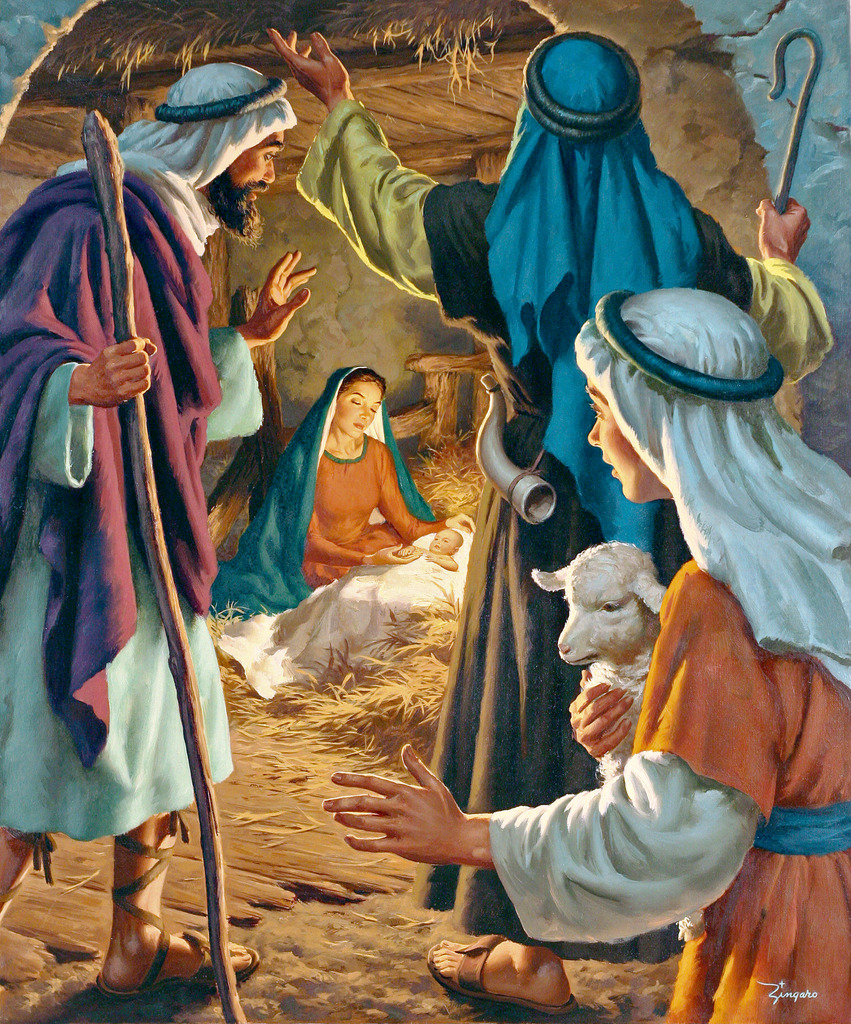
"The Star--that brilliant, glowing Star--stopped over a stable, a very poor structure cut into the side of the hill. I stood before it, the smell of the hay in my nostrils and the bleating of the animals in my ears, thinking that this could not be the place. It was too dirty, too common, to be the birthplace of a king! Josiah and I thought to leave and return to our sheep before morning. But then..." Grandfather paused and lifted his eyes towards the heavens,"...then we heard the cry of a newborn baby. And we knew. Those of us who had come--and there were many with Josiah and myself--pushed open the rough door and there He was, an infant in His mother's arms. The woman, his mother, she smiled up at us. She did not seem at all surprised to see a group of rag tag shepherds standing before her! She was so young, so pretty. We stared, all of us, and a man--much older than she--led us further into the cave and bade us to look down at the child."

"What did He look like?" asked Zachary eagerly. Surely the Son of God would be handsome and richly robed!

But Grandfather's answer disappointed him. "He looked like any other baby, Zachary. Like you, when you were born. Like your mother, when she was born. Like any other baby ever born. But then, He smiled. A tiny, newborn baby, only hours old, and He smiled. He looked into my eyes and He smiled. And I felt that I had always known Him, that He had always known me. I fell to my knees and I wept."

Grandfather fell silent, the image of the Star in his memory. Zachary closed his eyes and imagined the brilliance of that special Star. If it had happened once, such a beautiful, amazing sight, could it not happen again? Were not all things possible with God? "Grandfather?" the boy asked softly.

Grandfather's answer was equally soft. "Yes."

"If the Babe was God's own son, and the Star was sent so men would find Him, where is He now? Why doesn't everyone know?"

Grandfather sighed. "Some never saw the Star. It was a long, long time ago. Some have forgotten it. Once, about thirty years ago, there were rumors of a prophet who performed miracles. There are people who say He was the Messiah. " Grandfather shrugged. "I do not know. I only know what I saw on that night, what I never forgot. Remember this, Zachary, that God never forgets. He made a promise to us, His people. When the time is right, all the people in the world will know His Son."

"And the Star, Grandfather? Will it come again, do you think? More than anything in the world, I would like to see it!" Zachary's voice held the hope of a small child.

Grandfather smiled and laid a gnarled old hand on his grandson's head. "Do not give up your dream, Zachary! All men need a star to guide them. You are still young, little one, but not too young to follow a star, nor to dream of one."


Grandfather would say no more about the star he had seen. He spent the next few days in quiet thought and many times Zachary came upon him with his prayer cloth over his head. Zachary knew that his parents had forgotten his strange birthday wish. He saw chips of wood shavings near his mother's sewing basket, and heard the whinnying of a new donkey behind his father's workshop. But he did not repeat his wish out loud again, only thinking on it long and hard. If he could see the Star for himself, just once, he would know that God heard his voice, that he mattered.

The days before a birthday are long. Zachary helped around the house and in the shop. He  played with his friends and tried not to hope too much.

The night before his birthday, his mother came to kiss him goodnight. "Your big day is tomorrow," she said with a smile. "What a grown up boy you are becoming! Too big for foolish wishes, isn't that so? Zachary swallowed hard and nodded.

His father also came to bid him good night. "And in the morning, a birthday surprise, eh? I wonder what it will be!" he laughed. Then Father winked at Mother and rumpled Zachary's hair. Grandfather did not come to say good night before Zachary fell asleep, dreaming of dancing stars and singing donkeys.


The light woke him and at first Zachary thought it was still part of his dream. He sat up in bed and rubbed his eyes, realizing it must be the light of morning. But it did not feel like morning. His brain still felt clouded with sleep. He rubbed his eyes again and swung his legs over the side of his pallet.

And there was Grandfather, grinning widely, his eyes twinkling. "Have you seen your present?" he asked, but his hands were empty. Zachary shook his head. For a brief moment he forgot the day. "My present?" he asked.

"Follow me!" Grandfather beckoned and Zachary obeyed, tiptoeing around the pallet of his sleeping parents. Outside, it was still dark. Zachary thought they would head to the workshop where the surprise donkey slept, but Grandfather stopped midway in the yard and pointed overhead.

"There!" he said.

Then Zachary saw it. The Star! It stood high up in the sky, outshining every other star. It's beams angled into the window's of Zachary's house, shedding a light both bright and pure.

Zachary grabbed hold of Grandfather's hand. Neither one spoke.

"What is it?" asked Mother, her hair tumbling down her back from sleep. Father was rubbing his eyes in disbelief, standing there with Grandfather and Zachary. The beams from the Star enveloped them all in a beautiful light.

"The Star!" gasped Mother. She turned to Grandfather. "I remember you telling me of it when I was still a child. I never thought to see it. I had all but forgotten about it and the stories you used to tell."

"It's beautiful," said Father. "Zachary, I thought yours was a foolish wish. But I believe this Star is for you."

"For each of us, " said Grandfather. "The Star is a sign to all who seek God. The Star shines now, as it did long ago, for each of us. It will always shine, in our hearts and in our minds. And we must each, in our own ways, seek to follow it."

Mother hugged Grandfather tightly, then turned to Father. Lastly, she hugged Zachary long and hard, whispering to him, "Thank you for sharing your birthday wish with us. You are a wise and dear child."

"And," grinned Zachary, " a child with a new wooden toy camel and a new donkey!" Mother and Father laughed.

"But most of all, Zachary," said Grandfather, "you are a child with a star of your own to follow."

And, for the rest of his life, Zachary did.


Wednesday, November 26, 2014

A Star for Zachary: Part I

Zachary's birthday was coming soon. He thought long and hard about the present he would ask for. Birthdays came only once a year. It would be awful to waste a birthday wish!

"We are not rich people, Zachary," his mother had said. "Only one present."

Zachary knew his parents both worked hard. He knew his grandfather tried not to complain about the cold that made his knees ache because fuel was costly. Zachary knew that although his family had more than some, they were not rich. Somehow, though, it never felt as if they were poor.

"We have each other!" his father would say in his big, booming voice, lifting Zachary off the ground and swinging him up to his shoulders. Even when the fishing was poor and his mother's vegetable garden blighted with heat, Zachary understood that a family was much better than a wooden top or a new pair of sandals.

After much thought, Zachary decided what he wanted for his birthday.

He told his mother, whispering into her ear as she stirred the stew pot. "Zachary!" she said with a gay laugh. "What an idea! Better pick another gift. Perhaps a little carved camel, such as your friend James has." Mother knew where a smooth piece of wood was hidden that would make a wonderful camel. She went back to her stirring.

Zachary told his father. "Oh, no, son," he said. "Where do you get such thoughts? Listening to the stories of your grandfather? He is an old man and his mind is often confused. Such a present is not possible. Why not a sturdy little donkey of your own, now that would be a gift!"Father knew where such a donkey could be had in exchange for services. He continued swinging his hammer against the iron anvil.

Zachary told his grandfather. "Ah!" said Grandfather, and his eyes twinkles brightly. "An excellent choice! What could be better than a piece of the sky? What could be better than a star to call your own?"

"Mother and Father said that no one can own a star," said Zachary sadly. "They thought it was a foolish wish." It had seemed such a fine idea! Still, Grandfather had not laughed at his foolishness. Was such a thing possible?

Grandfather's voice took on his "story-telling" tone and Zachary settled back happily. Grandfather's stories of his days as a shepherd, spending long nights alone with only sheep for company, were always wonderful and, unlike Mother's, never hurried.

"I am an old man now," Grandfather said, "but once, when I was young--not much older than you, grandson--I too, searched for a star. My own grandfather, my Abba, he had told me what the prophets had said such a star would mean! I searched in the sky and, although I could barely read, in the words of great men. I listened at Temple and in the courts. Ah, they thought I was but an ignorant shepherd boy, but my ears could work just fine.

"I learned, Zachary, that there were many searching for a star, a sign that God had not forgotten us." Grandfather shook his shaggy gray head. "Those were terrible times, Grandson. Terrible times for our people. We needed to find the sign of God's promises."

Zachary nodded. "Father says that at the Temple the scholars still argue. Some say the prophecy of God has been fulfilled. Some say it has not."

Grandfather shrugged. "I do not have much in the way of education. I just know what I was looking for. I know that I needed to see a sign that we, God's chosen people, had not been forgotten."

"Mother says that God put the stars in the heavens to light the way for all of us. That no one person can own a star," said Zachary.

"Your mother is a wise and practical woman," said Grandfather. "But your mother is also wrong. She has forgotten the stories I told her at my knee, when she was very young. She has forgotten that our lives are not forever bound to this earth. She has forgotten how to hope."

"Why has she forgotten, Grandfather?"

Grandfather shrugged. "It is hard to be an adult, little one. There are too many cares. It is only old men and young boys who have time for dreams."

"But the star!" said Zachary. "You haven't told me the part about the star!" It was the part of Grandfather's stories that Zachary liked best, the part he always asked for. It was the part, Zachary reminded himself, that Mother said was just in Grandfather's imagination.

Grandfather was not to be hurried. "I'm coming to it, child. Many men, much wiser than I, hunted for the star. They studied the great scrolls of knowledge, they searched the heavens. Why, I heard that in Capernaum where there is a great telescope, learned men searched each corner of the heavens for years on end. Men from far distant countries also searched for it. They knew what the star would bring. It would mean that we had not been forgotten by God, but that he had sent his Son to us, to teach us and to help us."

Zachary's eyes had, as always, grown wide with wonder. "And did the Star come, Grandfather?"

Grandfather nodded, a faraway look in his eyes. "It come. It came on a cold and dark night, a night so silent that I could hear the heartbeat of my sheep. They seemed to know, too, that something was different. They huddled together in the night, their bleatings soft and scared. Then, suddenly, all was light! It rose up into the sky, so full of brilliance and brighter than any star I had ever seen! It was so bright that the other starts could not be seen at all! I stood and I stared at it and, it seemed to me, I heard singing far off in the distance. Even though I was cold, I felt the warmth of the light from the star. And I shouted for my friend Josiah, who was below me on the hill."

Grandfather was lost in his thoughts now. "And Josiah came running, his cloak flying around him, for he, too, had seen the star. We stood there, the two of us, just watching and listening."

Zachary tugged on Grandfather's sleeve. "And what about the sheep, Grandfather? What did they do?"

"Ah, the sheep, they all laid down together, one warm and soft ball, and they were silent, as if they,too, were listening. Josiah and I stood for a very long time, just watching."

"And, then, Grandfather? And then?" Zachary knew that the best part of the story was coming.

"And then, child, it began to move. Yes, the star moved! We knew, then, that it was not an ordinary star which stays in one place in the heavens. We knew this was a special star. It moved with all its brilliance and beauty, lighting the sky as it moved. And we followed it, leaving our sheep on the hills. Josiah and I followed it, and we were joined by others." He turned to look at his grandson. "Even now, when I think of it, I find it impossible to believe. A Star that traveled! Who ever heard of such a thing! And why should I, just a poor shepherd boy,why should I be allowed to see it? It was so long ago, child, that sometimes I think I imagined it, just as your mother says."

"But you didn't," said Zachary. "You didn't imagine it, Grandfather."

The old man shook his head. "No, I did not imagine it. It was real. I can close my eyes and see it still, that beautiful Star. The Star led us on that night, Zachary, stopping to let us rest, never ceasing its magnificent glow. Not even the passing clouds could hinder it."

"Where did the Star lead, Grandfather?" asked Zachary, who knew the answer. "To a palace? a castle? a place befitting the Son of God?"

But Grandfather did not answer for long moments. Zachary waited patiently. The story was worth the wait.


Look for Part II soon!

Tuesday, November 11, 2014

A Faint Purple Glow

My son is entranced by the iridescent purple glow as I snap the lightstick and bring the liquid to life. My hasty purchase at the Boardwalk 5 & 10 proves cheap entertainment for a four-year old that has thus far screamed and cried through most of our vacation. I slide the string through the hole in the miraculous tool, knot it, and show Kenny how to twirl it around his finger, the phosphorescence making a bright arc in the night sky. He laughs and claps his hands together.
            “Again, Daddy!” he commands and I obey, but this time I let the string slip from my grasp and the purple glow ascends into the black sky, arches, curves back to the beach. Kenny runs to its landing site on sturdy legs and I follow close behind, despite my practically new leather loafers quickly filling with sand.

            It is good to see Kenny laughing, enjoying himself. It seems as if everything at this beach resort has scared him or worries him, from the agonizingly long car ride to the ferocious pounding of the surf against the beach to the crowds and whirls of color at the amusement pier. All have been a source of pain for my young son.

            Kenny picks up the glowing stick and tosses it over his head. His eyes are bright with excitement and his alabaster cheeks reflect a faint purples glow from the light stick. The cylinder loops over his head, a single bright ray in the inky darkness.

            I glance back toward the boardwalk where Beth and the girls are still busy feeding quarters into arcade games. It is hot and noisy in the arcade. This has been the final agony for Kenny, who began a non-stop wail to the embarrassment of his three sisters and the exasperation of Beth. Her patience with Kenny is phenomenal, but I recognize that she, too, has limits. This is her vacation as well as mine. And so far, Kenny has made relaxation a dim hope. So I conceive my strategy and whisk Kenny off, leaving Beth and the girls with whatever peace and quiet reigns in a noisy arcade.

            Here the beach I feel alone, cut-off with only Kenny for company. The lights and the sounds of the vacationers do not penetrate to the water’s edge. Even the sound of the surf is quiet, muffled by the velvet night. Kenny revels in the coolness of the sand. Chubby fingers soon untie sneakers and peel off socks so he can dabble his toes in the same ocean that made him scream only hours ago. He splashes water at me—little imp—and I kick off my own loafers and roll up my khakis, joining him in his frolic.

            He is a beautiful child, my longed-for son. The moonlight reflects pale silver on his blonde head. His pert nose is charmingly pink with sunburn. But it is Kenny’s eyes that usually illicit comment, large hazel orbs that change color with his mood. His sisters are jealous of his long, curled lashes and perfectly arched brows. “Wasted on a boy,” they say and rumple his hair affectionately.

            It is the intelligence I see in his eyes that I admire and long to unlock. Born after only twenty-six weeks, Kenny spent his first six months struggling to survive. Beth and I logged countless hours at the hospital, hovering over his isolette, but it was Kenny who fought to breathe and move on his own, to keep his miniature heart pounding and blood rushing through his infinitesimal veins. “The size of sewing thread,” said one doctor.

            Kenny—unlike many infants born too soon—made it home, to us. He made it home to a life that continues to frustrate and challenge him and likely always will. I sigh deeply and pray that my grief is for Kenny, not my own shattered dreams.

            “Look, Daddy!” shrieks my son with Glee. He is trailing the purple light stick in the bubbles along the surf, tinting the water with purple rays. “Pretty!”

            “Wow, Kenny! That’s great!’ I holler back. He grins. Vacation miseries are forgotten. His world is reduced to only this light, this beach, his father’s rare undivided attention.

            Kenny has had a difficult year. So has Beth. Twice his under-developed lungs sent him to the hospital. Ear infections and sore throats have plagued him. His speech therapist has reckoned Kenny’s vocal skills to those of a two and a half year old. There is no way of knowing yet if his early birth affected his IQ.

            But Kenny’s eyes, so alive, convince me that somewhere inside my small son is an intelligent being. He tosses the light into the air, misses it, laughs at himself, does it again. He flashes me a beatific smile and tosses the stick to me. “Daddy, catch!”

            And I do. For a few moments, we are only a father and son, engaged in a normal game of catch. Then I cannot resist the urge to teach my son something new and I grab the glowing light stick. “Watch, Kenny!” I sketch a letter “K” into the dark night with the iridescent light, and a streak of faint purple remains for a brief moment. Kenny stares intently and I know that, on some level, he is analyzing this trick of his old dad. I draw the letter again, and say, “K. K is for Kenny.” And the purple glow fills the night as I sketch K and after K after K.

            Moments pass. The glow of the purple K’s fades. Kenny, gently, takes the light stick from my hand. Slowly, carefully, he traces a line in the sky. Then another at a 45-degree angle. Then a downward slash. Solemnly he says, “K. Is for Kenny.” Then he points the purple light to his chest. “Me.”

            My mouth opens wide. I want to tell Kenny how wonderful he is, how magnificent, all I ever hoped for in a son, but I say simply, “Yes. You.”

            He laughs. His little arms encircle my leg briefly. Then the fascination of the light calls him again and he tosses the stick further up the beach and races for it.

            Beth and the girls will find their own way back to the hotel from the bright lights of the boardwalk. Kenny and I race along the beach, the waves gently tickling our toes and our shoes forgotten, as he chases after his light, the faint purple glow a beacon in the night.


Thursday, November 6, 2014

How I Learned to Write

My grandmother always called it “the playroom,” but it was bereft of toys or games or anything else that would entertain two visiting grandchildren. Nonetheless, my brother and I spent hours in the drafty place—really just an afterthought our grandfather had tacked onto the dining room—while Mom and Nanny worked on Sunday dinner in the kitchen. A huge desk, immense to a child of six, occupied most of the space, complete with a swivel chair of cracked leather and lopsided proportions. The drawers of the desk were full of old receipts, pens that did not work, and papers from my father’s school days.

The other attraction to the room was a large wood closet, hand-crafted by Pop Pop out of cast-off wood. For some purpose unknown to my brother and me, the inside of the closet featured a set of steps that went nowhere. This intrigued us; we would take turns seeing how far we could go before our heads hit the ceiling. After this novelty wore off, my brother used it to play with his Slinky and toy cars.

But I turned my attention to the desk, that big and imposing piece of furniture with its drawers and pigeonholes and old ink blotter. I took the pens from the various drawers and tested them on the old green blotter, organizing the ones that still wrote into the little wooden boxes along the top of the desk. I carefully put all the papers into piles of size and color. I wrote my name over and over again on the backs of old Christmas cards.

And I made a discovery: deep in a bottom drawer, hidden under a set of oil paints, was a gray binder. The cover featured a Scottish terrier with a red plaid bow. There was still paper inside the binder, white paper with faint blue lines set close together.
I was enthralled.

I took the binder to my father. My brother and I knew that the toys and games we found in the house on Chester Pike once belonged to him; he was the only child to have ever lived in the large house with its curving staircases and high ceilings. He was sitting in the kitchen with my grandfather, talking about things at Westinghouse—the company where they both worked—when I came in with the binder.

My father took it from my hands. “Ah, I remember this! I think I had it in fifth grade.” He ran his hand over the cover, and then gave it back to me. “You can have it if you want.” I held it to me, prized possession that it was, and ran back to the playroom with it. I was already imagining the feel of a pen in my hand, the flow of the ink as it met the white paper. In my imagination, a black Scottish terrier frolicked across the yard, meeting a girl with a red and white bow in her hair. Together, they solved mysteries.

And so, the adventures of Scotty and Alice began to fill the lined pages of the notebook, written in pencil, careful block printing that I tried to make imitate the text of my beloved books. I didn’t plan the stories out in any way; I just wrote. Alice and Scotty found her grandfather’s missing watch, and discovered a nest of baby robins, and located Alice’s brother lost roller skate key. I filled all the pages in the binder, then looked for other places to put my words.

The cast-off envelopes in my grandfather’s big desk were full of blank spaces. Soon, they were full of words. So were the backs of old receipts. They were all stuffed into the gray Scotty binder.
I was becoming a writer. But, except for school assignments, I kept my writing to myself.

The practice on scraps of paper helped me. My teachers read my assignments out loud and marked my papers with big red A’s and stickers. But even as a teacher was extolling the virtues of my latest story, I would be constructing a new one in my head. It was my secret; I lived inside my head, creating my own characters and situations. I could scribble away for hours, content in a world I created. In high school, a teacher submitted one of my poems to a contest and I won. But when the guidance counselor asked me what I wanted to study in college, I said teaching. Teaching was, my parents had pointed out, a safe career for a woman.

I became a Teacher. When people asked me what I did, I said I was a teacher.

I kept writing, filling my stories into new binders, writing into spiral notebooks. I wrote and I taught and I married and raised a family. My family gave me more fodder for stories. My students became poems. But still, my writing was my secret vice, stealthily done after real work was accomplished. My stack of spiral  notebooks grew.


Finally, one summer I got brave. I enrolled in the Writing Institute at West Chester University, spending six weeks in a trailer on the Bull Center parking lot. I wrote. I wrote and I shared and I edited and I heard people—fellow students and our instructors—tell me something I had never heard before: that my writing was good enough to be published. In fact, Lynn told me, “I can’t believe you have not been discovered before.”

Now I write in the open. I write and I blog and I publish my books. Most of the time, people like what I write. Once in a while, they do not. I do not care. I write because I have to, because the stories that inhabit my head beg to be told. I write because it fills an empty void inside of me. I write because it brings me joy.

I am still a Teacher. And a Wife.And a Mother.And now a College Professor and a Literacy Specialist and an Instructional Coach. These are the roles I fulfill for other people.

But I am a Writer for me.